
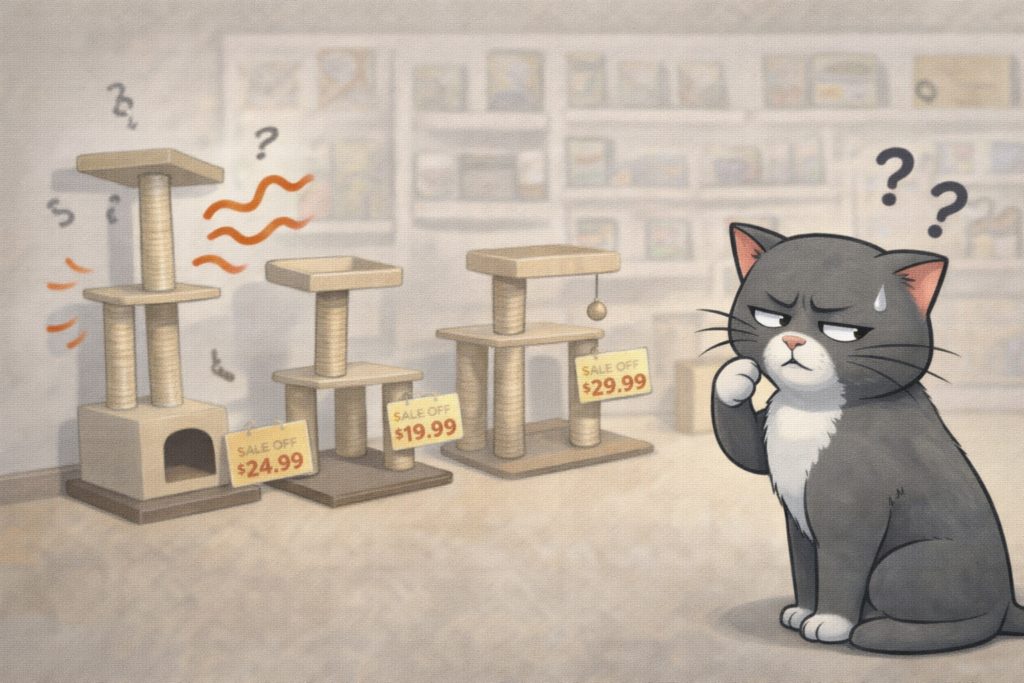
Buying a cat tree should be straightforward.
Yet between 2024 and 2026, many top-selling cat trees failed in the same predictable ways—often just weeks after entering real homes.
After reviewing hundreds of low-star reviews across top-selling cat trees from 2024–2026, clear failure patterns emerged.
Despite strong sales and decent average ratings, the same complaints appeared repeatedly:
✖️ wobbly, cheap, too small, missing parts, hard to assemble.
These aren’t isolated defects.
They are design shortcuts that only reveal themselves once cats start using the tree every day.
👉 At the end of this article, you’ll find a 3-minute reality-check table showing how to screen any cat tree by scanning reviews—before you buy.
Scam #1: Unstable Structures That Wobble, Tip, or Collapse
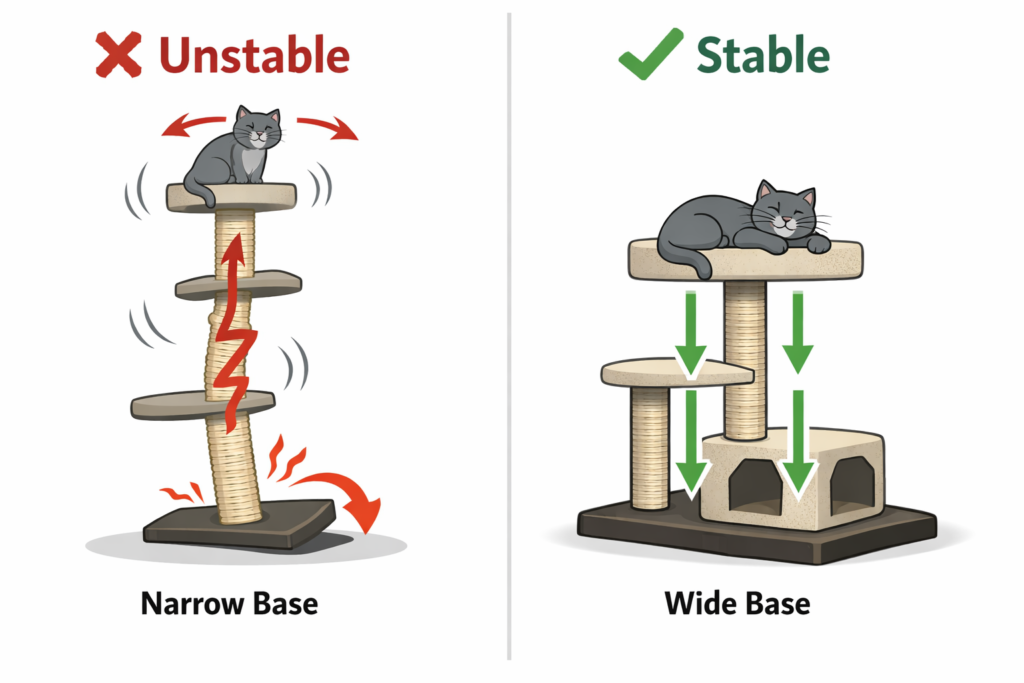
Instability is the most common complaint in low-star reviews.
Many cat trees seem acceptable when lightly touched.
Problems appear when a cat jumps, lands, or pushes off with force.
Terms like unstable, wobbly, shaky, and tips over appear repeatedly across brands and price ranges.
❓Why Stability Matters to Cats (Not Just Humans)
According to guidance from the American Veterinary Society of Animal Behavior, cats are highly sensitive to environmental stability and predictable movement.
Surfaces that shift or wobble under load can increase stress and avoidance behavior.
In simple terms:
If the structure moves when the cat lands, many cats stop trusting it.
❓How to Spot Built-In Instability (No Specs Needed)
Ask one question:
When a cat lands, does movement spread through the entire structure?
High-risk designs often combine:
-
Tall height with a narrow base
-
Multiple platforms relying on one thin post
-
Sway that doesn’t stop immediately
If the whole tree moves together, instability is structural—not accidental.
Scam #2: “Feels Solid at First” but Fails Under Repeated Use
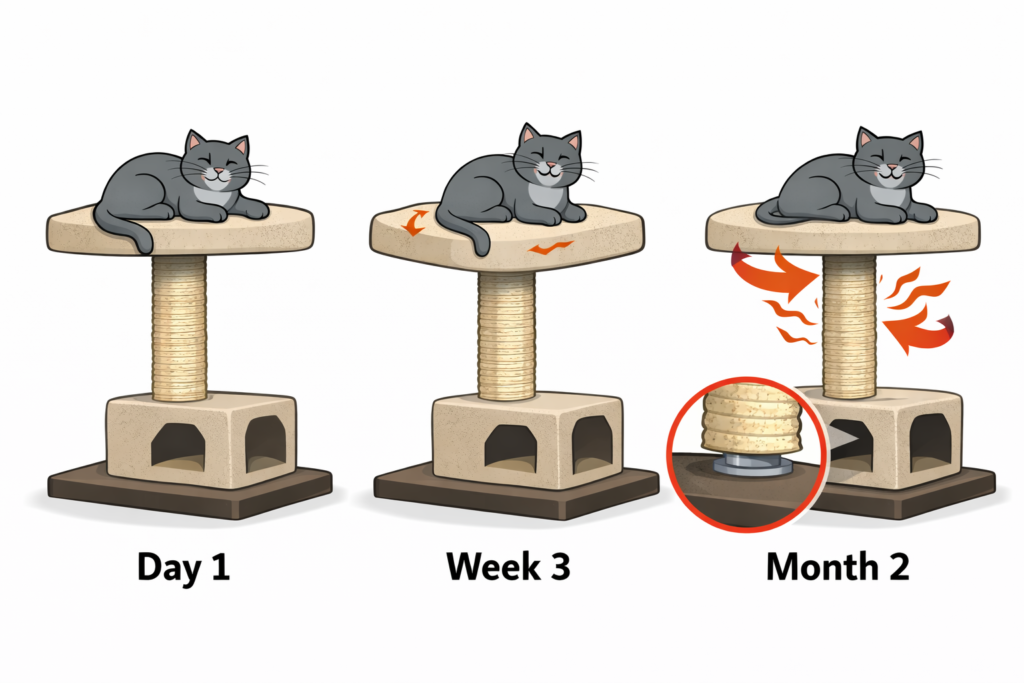
Many low-star reviews follow the same timeline:
“It felt sturdy at first.”
“Then it loosened.”
“Then parts broke.”
Cats don’t test a cat tree once.
They jump, land, twist, scratch, and push off the same points every day.
That repetition amplifies small weaknesses:
-
Platforms slowly compress and lose rigidity
-
Thin posts loosen and begin to rotate
-
Cheap connectors lose tension after hundreds of micro-movements
Failure is gradual—but predictable.
If reviews mention flattened, sagging, post spins, or needs constant retightening, the design is already telling you its limits.
Scam #3: Size Illusions That Don’t Match Real Cats
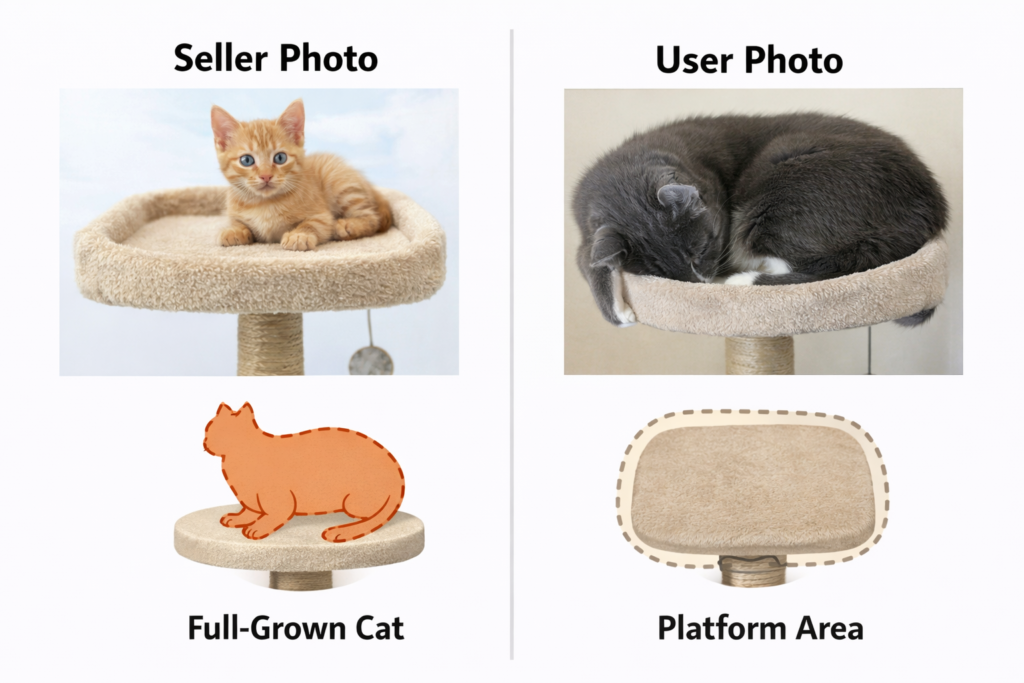
Another recurring complaint is size mismatch.
Even listings labeled “for adult cats” often receive low-star reviews mentioning:
too small, smaller than expected.
Height photographs well.
Usable surface area determines whether cats actually use the tree.
Platforms that are too narrow lead to unused levels, poor weight distribution, and reduced long-term stability.
Scam #4: Assembly Nightmares (Usually Not User Error)
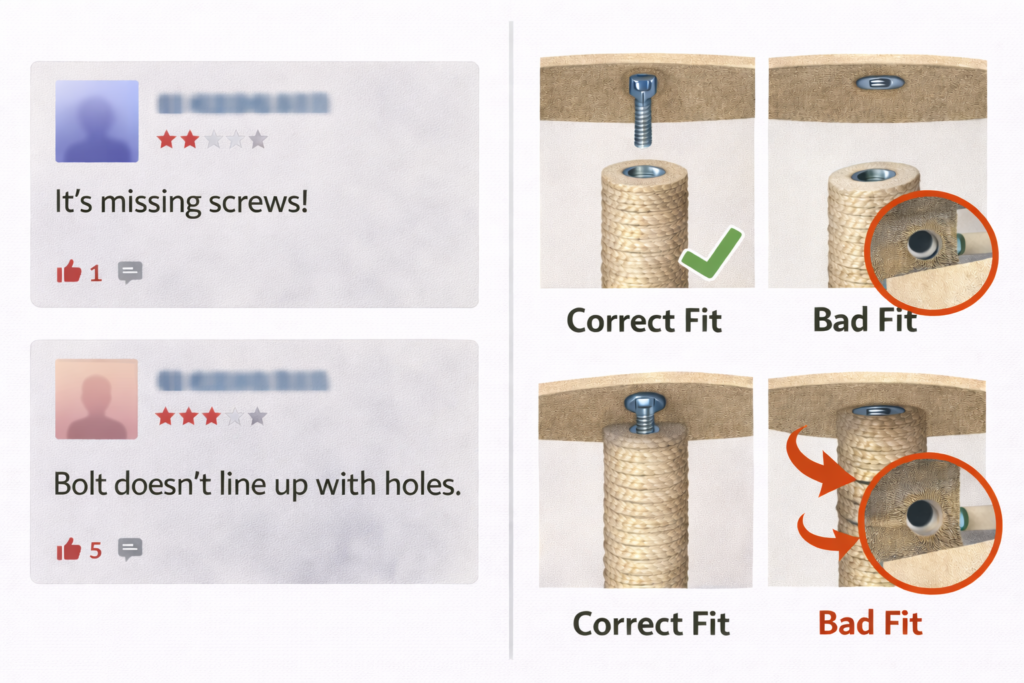
Many buyers assume they made a mistake.
But repeated low-star complaints tell a different story:
missing screws, holes don’t line up, instructions wrong.
When the same issues appear across many reviews, they point to manufacturing and quality control problems—not bad assembly skills.
Scam #5: Comfort & Health Issues That Matter in Small Spaces
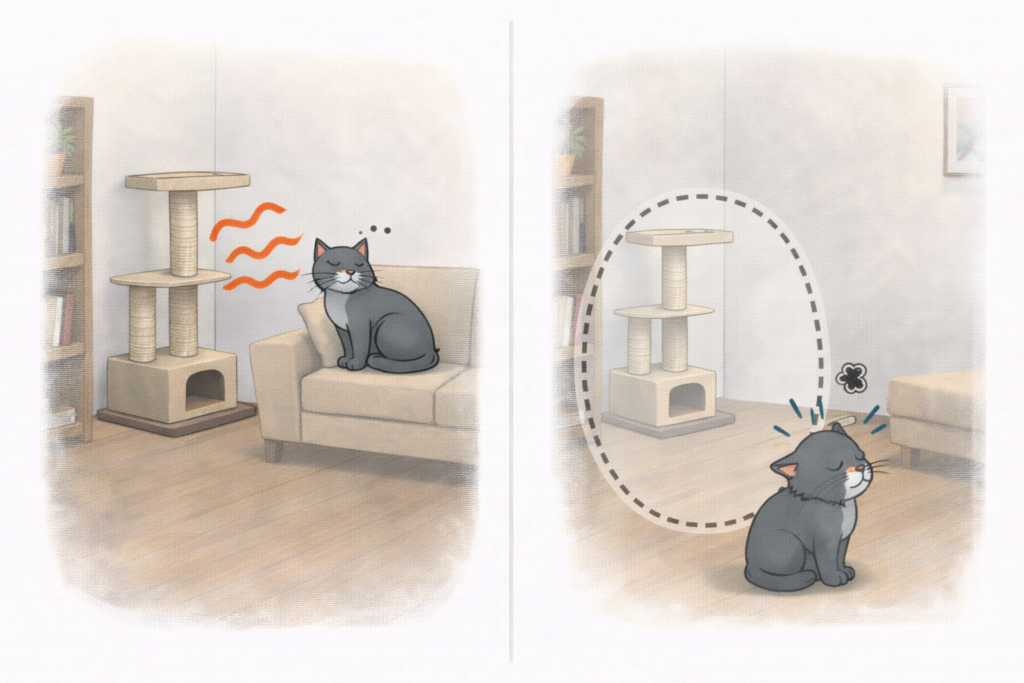
Some reviews mention chemical smell or shedding.
Guidance from the ASPCA notes that strong odors, unstable surfaces, or poorly sized environments may discourage normal resting and usage behaviors—especially in indoor or apartment settings.
For scent-sensitive cats or small spaces, these issues can lead to complete avoidance.
What Actually Survives the Checklist
After reviewing a large volume of real user feedback, these four styles are among the few that don’t fail the basic reliability checks:
- No widespread complaints about wobbling or instability
- No recurring issues with strong odors or confusing instructions
- No consistent reports of poor build quality
The differences aren’t about quality — they’re about size, structure, and which homes they realistically fit.
Tall & Compact |
Extra Tall & Multi-Level |
Small & Simple |
Tall with Wide Base |
|
| One-Sentence Fit Summary | Want vertical space without sacrificing floor area | Large homes with multiple, very active cats | Small apartments or first-time cat owners | Homes with fixed space for a large, stable cat tree |
| Where to Buy | 👉 View on Amazon | 👉 View on Amazon | 👉 View on Amazon | 👉 View on Amazon |
| Size / Footprint (Most Important) | Tall (~72 in) with a compact base | Tallest (~80 in) with a large footprint | Shortest (~50 in), smallest base | Tall (~71 in) with the largest base |
| Structural Design (Cat Personality) | Clear vertical layout, balanced movement | Most complex, high exploration value | Simple, low-stress structure | Dense, grounded, furniture-like |
| Best for Which Cats | Moderately active cats that enjoy height | Very active cats that love climbing | Senior, cautious, or low-energy cats | Medium-activity, larger cats |
| Scratching / Climbing Features | Balanced posts + platforms | Most scratching paths and levels | Basic scratching, daily use | Concentrated scratching zones |
| Ease of Cleaning & Maintenance | Medium | Lower (many levels, more fabric) | Easiest to clean | Medium–low (large surface area) |
| Multi-Cat Friendly | Up to 2 cats | Best for multi-cat homes | Not ideal for multiple cats | Up to 2 cats |
| Suitable for Large Cats | ✔ Yes | ✔✔ Very suitable | ⚠ Limited | ✔ Yes |
| Assembly Difficulty | Medium | Most complex | Easiest | Medium–high |
Quick Reality Check: How to Screen a Cat Tree in 3 Minutes
Before buying, go straight to 1–3 star reviews and use the review search.
| Risk Category | Keywords to Search | What Repetition Signals |
|---|---|---|
| Structural Stability | wobbly, unstable, shaky, tips over, collapses | Base or post design can’t absorb repeated landings |
| Material & Durability | cheap, flimsy, broke, cracked, flattened, sagging | Materials fail under daily use |
| Size Mismatch | too small, smaller than expected, not for adult cats | Visuals exaggerate usable space |
| Assembly & QC | missing parts, missing screws, holes don’t line up, instructions wrong | Manufacturing inconsistency |
| Comfort & Health (context-dependent) | chemical smell, strong odor, shedding | Higher risk in small or sensitive homes |
How to use this table:
-
One or two mentions can happen
-
Repeated patterns across many reviews signal design risk
-
Clusters indicate structure—not bad luck
Final Takeaway
Most cat tree failures aren’t random.
They follow the same patterns, hidden behind high ratings and polished photos.
Once you understand how cats actually use vertical furniture—and how repeated daily motion exposes weak designs—those patterns become easy to spot.
Avoiding bad purchases becomes far simpler than trusting a “best seller” label.
Affiliate Disclosure: Some links may be affiliate links, but product selection is based on independent analysis, not sponsorships.