
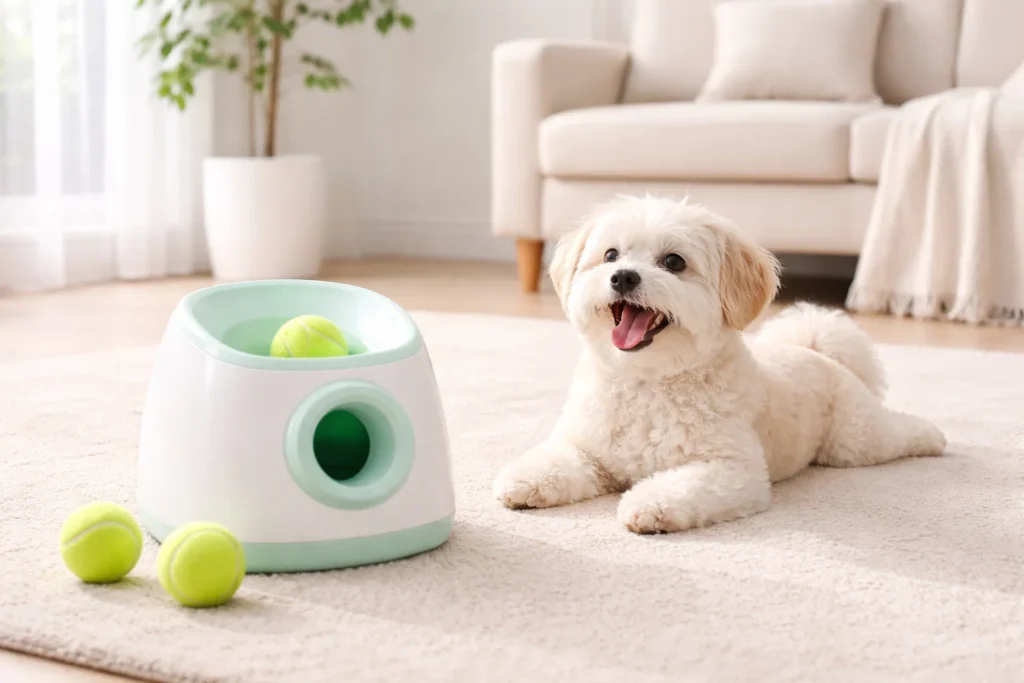
When most people first come across an automatic ball launcher, it seems like a simple device — something that throws a ball for your dog.
But once you actually start using it, you quickly realize it does much more than that.
It influences how your dog exercises, how intense the activity becomes, and even how dependent your dog becomes on the game itself.
For small dogs in particular, choosing the right launcher directly affects two key things:
👉 whether the exercise is safe
👉 and whether your dog is willing to stay engaged over time
For many owners, choosing the right automatic ball launcher for small dogs is not just about convenience, but about creating a safe and sustainable way for their dog to stay active.
So instead of asking “Should I buy one?”, the better question is: How do I choose the right one?
Is an Automatic Ball Launcher Better for Indoor or Outdoor Use?
This is one of the most common misunderstandings.
Most automatic dog ball launchers are labeled as “indoor & outdoor.”
However, in real-world use, these two scenarios require very different performance.
When used indoors:
- Space is limited
- Distances are shorter
- Safety and control are more important
When used outdoors:
- There is more space
- Distances are longer
- The intensity of movement increases
For small dogs, a more practical way to evaluate a launcher is this:
👉 Does it perform well at short distances in a controlled indoor environment?
Because in everyday life, most usage actually happens in smaller, indoor or semi-contained spaces.
Why Most Products Are “Universal” — and Why You Still Need to Be Selective
When choosing an automatic ball launcher for small dogs, this is where universal products require extra attention.
If you browse Amazon for automatic ball launcher for dogs, you’ll quickly notice:
👉 Most products are not labeled specifically for small dogs.
This is not because manufacturers ignore small breeds, but because:
- Products are designed with adjustable distance settings
- Standard tennis balls are used as a universal format
- The goal is to serve a wider range of users
In other words, these are universal designs.
However:
👉 Universal does not mean equally suitable for every dog.
For small dogs, the key question becomes:
Whether the launcher is already gentle and safe enough at its lowest setting.
Key Features an Automatic Ball Launcher for Small Dogs Should Have
Instead of focusing on whether a product is “small-dog specific,” it is more practical to evaluate how it actually performs.
1. Does It Offer Clearly Adjustable Distance Levels?
A well-designed automatic tennis ball launcher should have multiple distance settings, with noticeable differences between them.
For example:
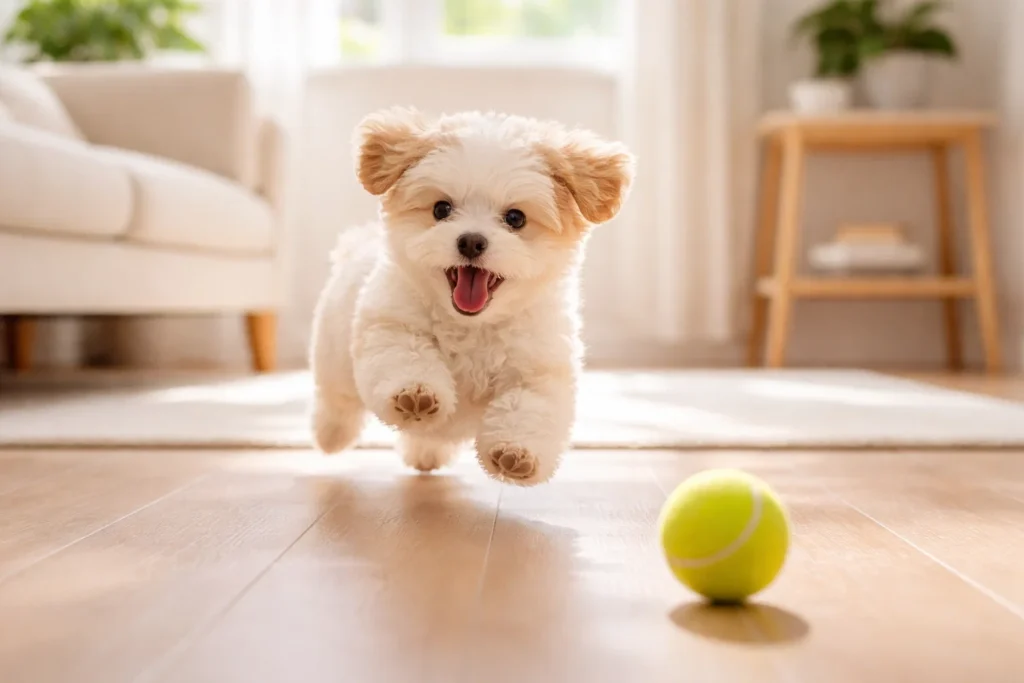
- The lowest setting should suit indoor, short-distance play
- The middle setting should support daily activity
- The highest setting should be reserved for larger outdoor spaces
If the lowest setting is still too far, it already exceeds what is comfortable for a small dog.
2. Is the Ball Size Suitable for Small Dogs?
Many devices use standard tennis balls by default.
For some small dogs, this can lead to:
- Difficulty carrying the ball
- Frequent dropping
- Reduced motivation to play
If the launcher supports mini balls, or at least allows different ball sizes, it usually provides a much better experience.
3. Does the Launch Force Actually Decrease at Lower Settings?
Some machines adjust distance but maintain similar launch force.
This creates a problem:
👉 Even at lower settings, the ball may still feel too strong or fast.
A better design ensures that lower settings are noticeably gentler, making it easier for small dogs to adapt.
4. Is There a Built-in Delay Before Launching?
This is a small feature that makes a big difference.
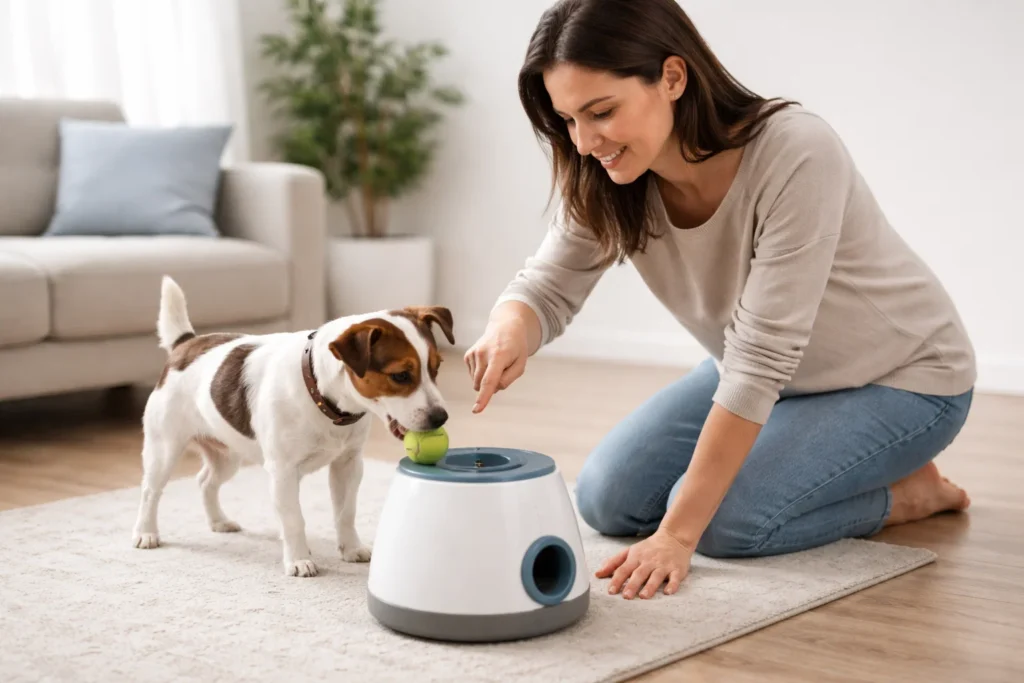
A delay allows the dog to move away from the launch point, reducing the risk of close-range impact and improving overall safety.
5. Is It Stable for Indoor Use?
Many products claim to work indoors, but actual performance varies.
Things to look for include:
- Whether the ball bounces unpredictably
- Whether the noise level is manageable
- Whether the launch direction is consistent
These factors directly affect whether the device can be used comfortably on a daily basis.
6. Why It’s Better to Choose a “Grow-With-Your-Dog” Option
Many people focus only on whether a launcher works right now.
A well-designed automatic ball launcher for small dogs should not only work at the current stage, but also adapt as your dog becomes more active over time.
But in reality:
- Your dog’s strength will increase
- Their endurance will improve
- Their play habits will become more consistent
If the device lacks flexibility, it may quickly become unsuitable — either too weak or too intense.
A more practical approach is:
👉 Choose a launcher that starts gentle but allows for gradual increases in intensity.
This not only saves cost over time, but also helps maintain a stable routine.
7. How to Use It Safely in Different Scenarios
Indoor Use: Best for Daily Exercise
When using the launcher indoors:
- Start with the shortest distance setting
- Control the pace of repeated launches
- Make sure the floor is not slippery
This creates a safer and more controlled environment for regular activity.
Outdoor Use: Best as a Supplement, Not a Replacement
When used outdoors:
- You can gradually increase distance
- Avoid starting with maximum settings
- Prevent continuous high-intensity running
Otherwise, it may lead to fatigue or minor strain.
FAQ
Can small dogs use universal automatic ball launchers?
Yes, but only under certain conditions.
The most important factor is whether the lowest setting is already suitable for a small dog’s strength and pace.
If the lowest setting is still too intense, it can create unnecessary strain.
Also, if the launcher only supports standard tennis balls, it may reduce usability for smaller breeds.
Choosing a model that is already gentle at lower settings is more important than simply relying on adjustability.
Will an automatic ball launcher make my dog overly excited?
It can, especially for dogs that naturally enjoy chasing.
The continuous launch cycle can push the dog into a highly stimulated state. Without proper control, they may struggle to stop.
A better approach is to:
- Limit each session to around 10–15 minutes
- Clearly define start and end points
- Combine with other activities such as walking or sniffing
Can long-term use affect joints?
Yes, if used improperly.
Risks increase when:
- Distances are too long
- Surfaces are too hard or slippery
- Sessions are too long
Managing intensity and duration is key to preventing issues.
What if my dog doesn’t return the ball?
This is very common and is part of the training process.
You can approach it step by step:
- Start with manual throwing
- Teach your dog to return the ball to you
- Gradually introduce the machine
- Reinforce the behavior with rewards
Patience is essential — it won’t happen instantly.
Can it replace daily walks?
No.
An automatic ball launcher provides physical exercise, but it cannot replace:
- Sniffing behavior
- Social interaction
- Environmental stimulation
It works best as a supplement, not a replacement.
Will I need to replace it as my dog grows?
Not necessarily.
If you choose a launcher with a wide adjustable range from the beginning, it can continue to meet your dog’s needs over time.
A Good Automatic Ball Launcher Should Grow With Your Dog, Not Just Work for Today
Choosing an automatic ball launcher for a small dog is less about finding a “perfect product” and more about finding the right balance.
What matters most is not how far it can throw or how many features it has, but whether it starts gentle, stays safe, and adapts as your dog grows.
A well-matched launcher doesn’t just make play easier — it creates a more consistent, enjoyable, and sustainable way for your dog to stay active.