
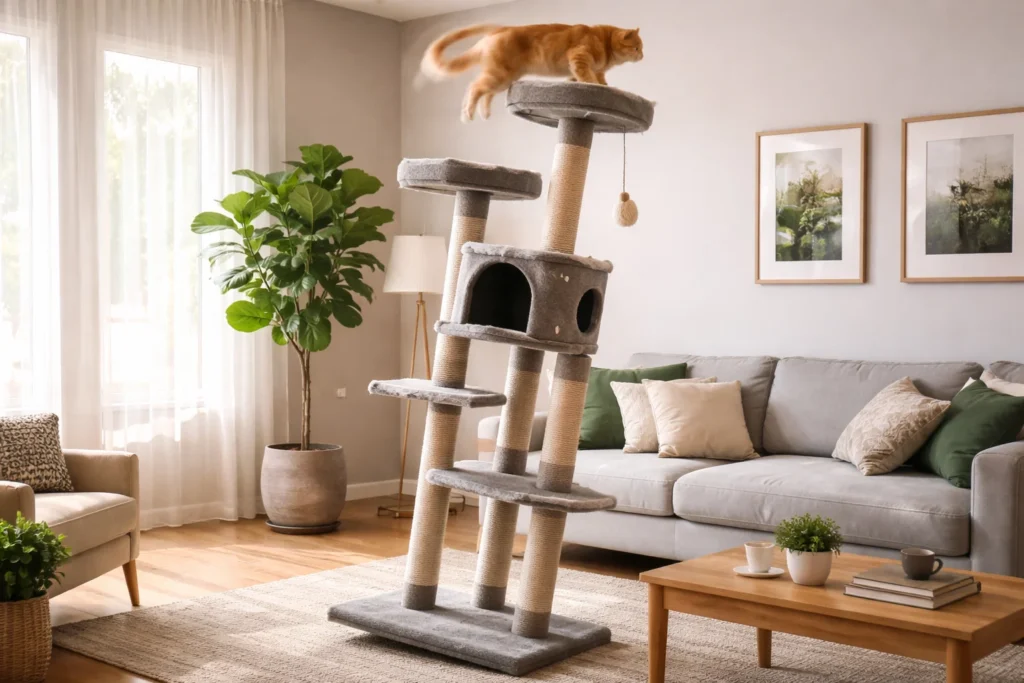
How to Make a Cat Tree More Stable
If you’re searching for how to make cat tree more stable, you’re not alone.
After reviewing a large number of popular cat tree products, one pattern appears again and again in mid- and low-rating reviews: wobbly, unstable, shakes, tips over.
Cat tree wobbling isn’t a rare defect — it’s one of the most common real-world problems cat owners face.
The good news is that most unstable cat trees can be fixed — as long as you identify the cause correctly.
Why a Wobbly Cat Tree Is a Bigger Problem Than It Looks
A cat tree that wobbles isn’t just annoying.
Over time, instability can lead to:
-
Cats hesitating or refusing to climb
-
Upper platforms being completely unused
-
Loud movement or tipping at night
-
Increased risk of collapse or injury
-
Faster wear on screws, joints, and base materials
In short, wobbling shortens both safety and lifespan.
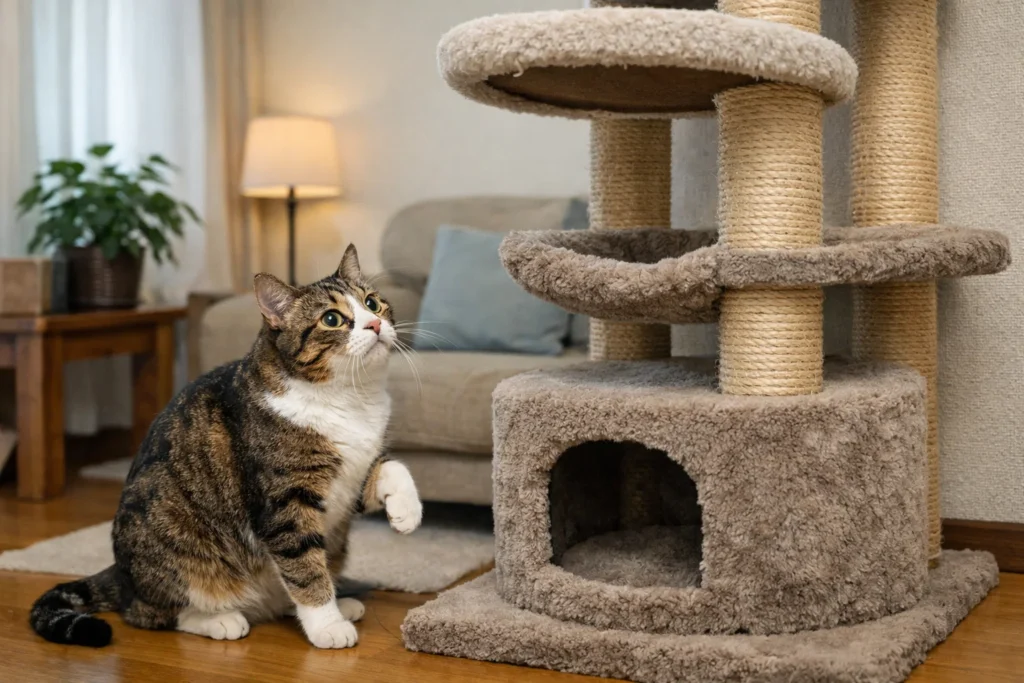
If a New Cat Tree Wobbles, Don’t “Wait and See”
If a newly purchased cat tree feels unstable, don’t assume it will settle with time.
Small movement often turns into:
-
Enlarged screw holes
-
Shifted center of gravity
-
Permanent structural weakness
Early diagnosis is easier, safer, and far less costly than late correction.
What This Guide Will Help You Do
This article is not here to tell you to replace your cat tree immediately.
Instead, it will help you:
-
Identify why your cat tree wobbles
-
Decide whether it’s an installation, environment, or structural issue
-
Apply the right fix for your situation
-
Extend the usable life of your cat tree safely
Why Do Cat Trees Wobble?
Most cat tree stability issues come from one (or more) of the following:
-
Assembly or connection problems
-
Uneven flooring or carpet compression
-
Lightweight or narrow bases
-
Height and structural design
-
Design flaws that appear repeatedly in reviews
Before learning how to fix a wobbly cat tree, it’s essential to know which type of wobble you’re dealing with.
Before Fixing Anything, Identify Your Type of Wobble
This step matters more than any individual fix.
Different wobble causes require completely different solutions.
Random adjustments often waste time and don’t solve the root problem.
Quick Cat Tree Stability Check
-
Are all screws fully tightened?
-
Is the tree placed on carpet or uneven flooring?
-
Is the base smaller or lighter than the upper platforms?
-
Is the tree tall with a single main support post?
-
Do multiple reviews mention wobbling or instability?
If several answers point to height or reviews, the issue is likely structural.
Fixing a Wobbly Cat Tree: Match the Fix to the Cause
Not all wobbling means the same thing.
Choose the solution that fits your diagnosis.
Basic Fixes for Light Wobble
If the issue is assembly or flooring:
-
Retighten all screws from the base upward
-
Rotate or reposition the tree to test floor level
-
Perform routine tightening every few weeks
Reinforcement Fixes for Moderate Wobble
If the base feels unstable or top-heavy:
-
Add non-slip pads under the base
-
Increase base weight
-
Widen the footprint with a solid base board
Structural Fixes for Serious Wobble
If the tree sways at upper levels:
-
Anchor the cat tree to the wall
-
Reinforce vertical load paths
-
Stop relying on screw tightness alone
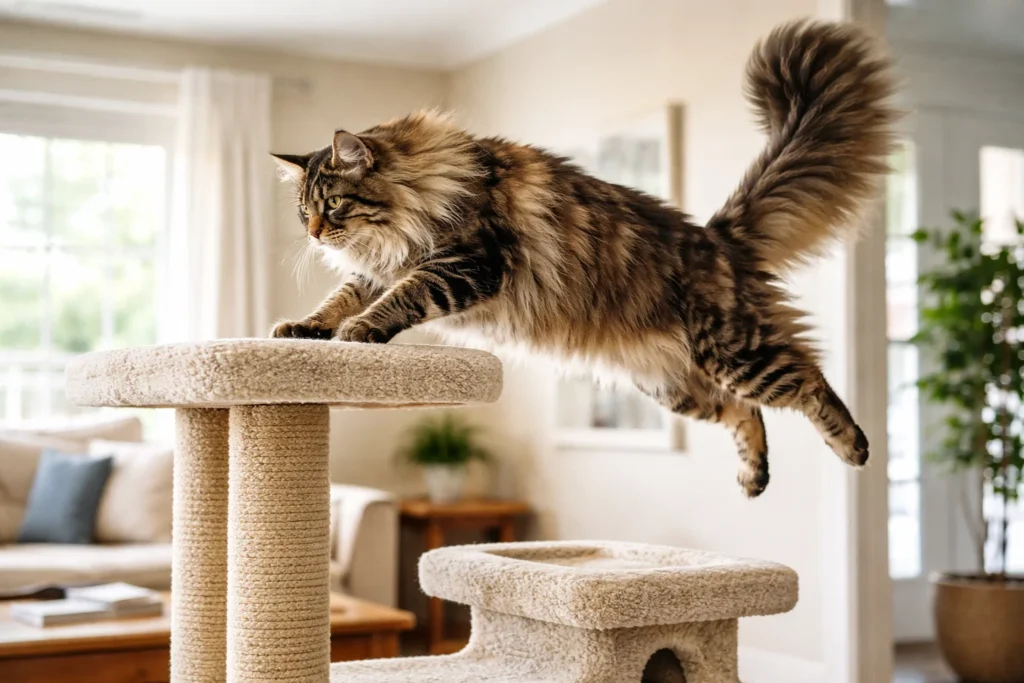
Why Extra Large Cat Trees Wobble More
Many owners ask how can I make my extra large cat tree more stable.
Extra large cat trees face unique challenges:
-
Greater height amplifies side-to-side force
-
Multiple platforms create leverage
-
Single-post designs carry higher risk
For tall trees, wall anchoring is often recommended — and sometimes essential.
Big Cats Change the Stability Equation
Large breeds such as Maine Coons or Ragdolls don’t just weigh more — they land with stronger lateral force.
This magnifies:
-
Narrow bases
-
Tall single-post designs
-
Flexible or lightweight materials
Even well-assembled trees may need reinforcement from day one for big cats.

Check for “Wobble Signals” in Reviews — Even If You Haven’t Had Issues Yet
Even if your cat tree hasn’t started wobbling, it’s worth checking reviews now.
Search for words like:
-
wobbly
-
unstable
-
shakes
Repeated mentions often indicate a design-level weakness.
Catching this early allows you to reinforce before problems appear.
When Is It Safer to Replace Instead of Fix?
In some cases, replacement is the safer choice.
Consider switching if:
-
Structural wobbling remains after anchoring
-
The base or posts are already deformed
-
The design isn’t suitable for tall trees or big cats
At best, an unstable tree may go unused.
At worst, a collapse can cause serious injury.
If You’re Considering a Replacement: Look for Fewer Wobble Complaints
If fixing feels risky or complicated, choosing a more stable design can bring peace of mind.
Based on review patterns, more stable cat trees tend to have:
-
Wider, heavier bases
-
Multiple vertical supports
-
Lower centers of gravity
-
Fewer repeated wobble complaints
| Dimension | Tall & Compact | Extra Tall & Multi-Level | Small & Simple | Tall with Wide Base |
| One-Sentence Fit Summary | Want vertical space without sacrificing floor area | Large homes with multiple, very active cats | Small apartments or first-time cat owners | Homes with fixed space for a large, stable cat tree |
| Where to Buy | 👉 View on Amazon | 👉 View on Amazon | 👉 View on Amazon | 👉 View on Amazon |
| Size / Footprint (Most Important) | Tall (~72 in) with a compact base | Tallest (~80 in) with a large footprint | Shortest (~50 in), smallest base | Tall (~71 in) with the largest base |
| Structural Design (Cat Personality) | Clear vertical layout, balanced movement | Most complex, high exploration value | Simple, low-stress structure | Dense, grounded, furniture-like |
| Best for Which Cats | Moderately active cats that enjoy height | Very active cats that love climbing | Senior, cautious, or low-energy cats | Medium-activity, larger cats |
| Scratching / Climbing Features | Balanced posts + platforms | Most scratching paths and levels | Basic scratching, daily use | Concentrated scratching zones |
| Ease of Cleaning & Maintenance | Medium | Lower (many levels, more fabric) | Easiest to clean | Medium–low (large surface area) |
| Multi-Cat Friendly | Up to 2 cats | Best for multi-cat homes | Not ideal for multiple cats | Up to 2 cats |
| Suitable for Large Cats | ✔ Yes | ✔✔ Very suitable | ⚠ Limited | ✔ Yes |
| Assembly Difficulty | Medium | Most complex | Easiest | Medium–high |
Final Thoughts
If you’re worried about your cat tree wobbling, that concern is completely valid.
Most cat owners aren’t trying to replace furniture constantly —
they just want something their cat can use safely and confidently.
The goal isn’t perfection.
It’s understanding the risk early, fixing what can be fixed, and choosing safer options when needed.
A stable cat tree means fewer worries for you —
and a space your cat actually wants to use.
👉 Want more real-world cat tree buying tips? Check 2026 Cat Tree Scam Checklist: Why 80% of “Best Sellers” Are Traps
Affiliate Disclosure: Some links may be affiliate links, but product selection is based on independent analysis, not sponsorships.