
Your arm gives out. Your dog doesn’t.
If that sounds familiar, an automatic ball launcher for dogs might be exactly what you need. These machines throw the ball for you — so your dog gets a full fetch session while you just watch.
This guide covers everything in one place: how to pick the right launcher, which size fits your dog, how to train your dog to use it, and how to keep it running. Where you need more detail, we link out to our full guides.
📋What this guide covers:
What a ball launcher is and whether it’s right for you ·
What to look for before buying ·
Choosing by dog size · Top-rated picks · First-time setup and training · Maintenance tips · FAQ
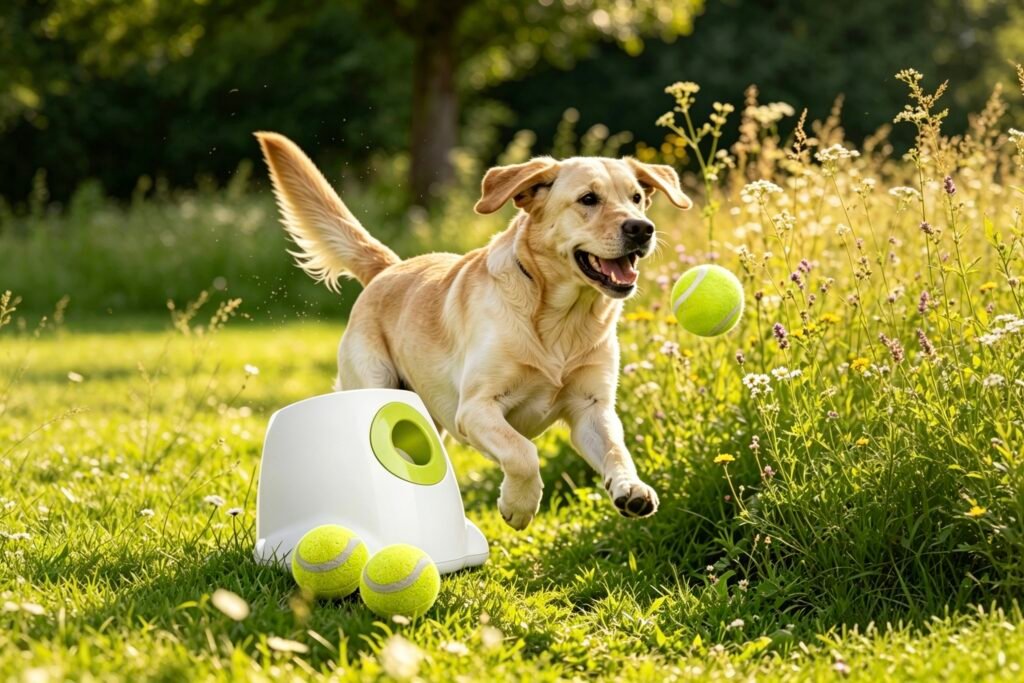
What Is an Automatic Ball Launcher for Dogs?
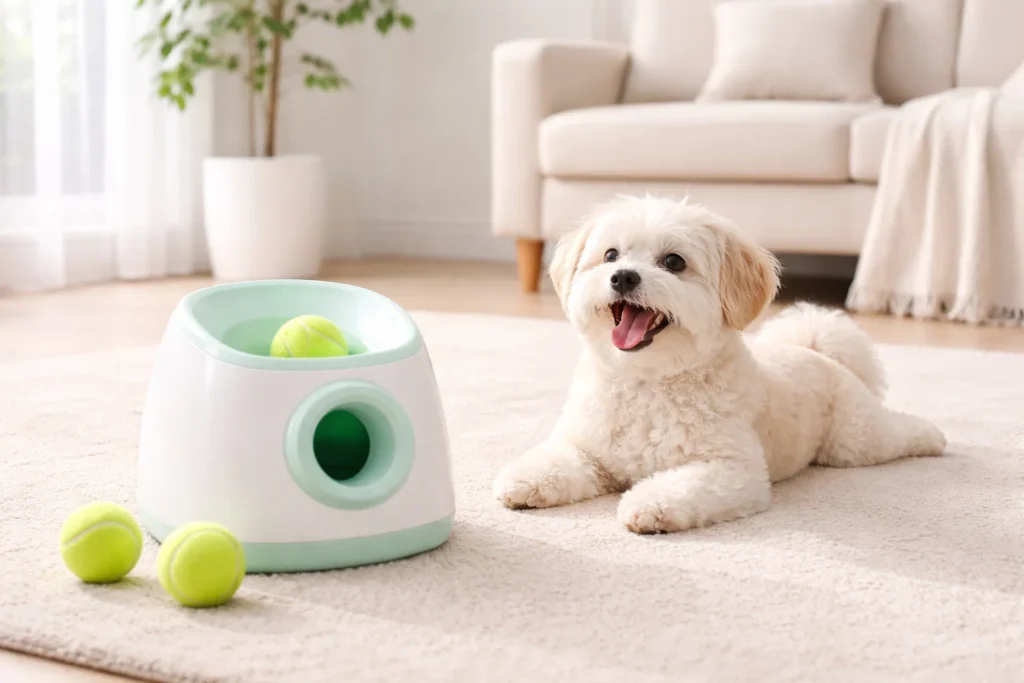
An automatic ball launcher is a motorized device that flings a tennis ball without any throwing from you. You load a ball into the top, and the machine does the rest.
Most models let you adjust the launch distance and angle. Many have a safety sensor that stops the machine from firing if your dog gets too close. Some run on batteries, others plug into the wall.
They’re popular with people who have joint pain, work long hours, or own high-energy breeds that could chase a ball all day.
Are Automatic Ball Launchers for Dogs Worth It?
A ball launcher works best when your dog already loves fetch. If your dog chases and retrieves with enthusiasm, they’ll often learn to use the launcher on their own within a few sessions.
| Good fit if… | Not the best fit if… |
| Your dog loves fetch and has lots of energy | Your dog isn’t interested in fetch |
| You want hands-free exercise for your dog | Your dog is easily startled by noise or fast movement |
| You have limited mobility or a busy schedule | Your dog is under 1 year old (joints still developing) |
| You own a high-energy breed (Lab, Retriever, Shepherd) | Your yard or available space is very small |
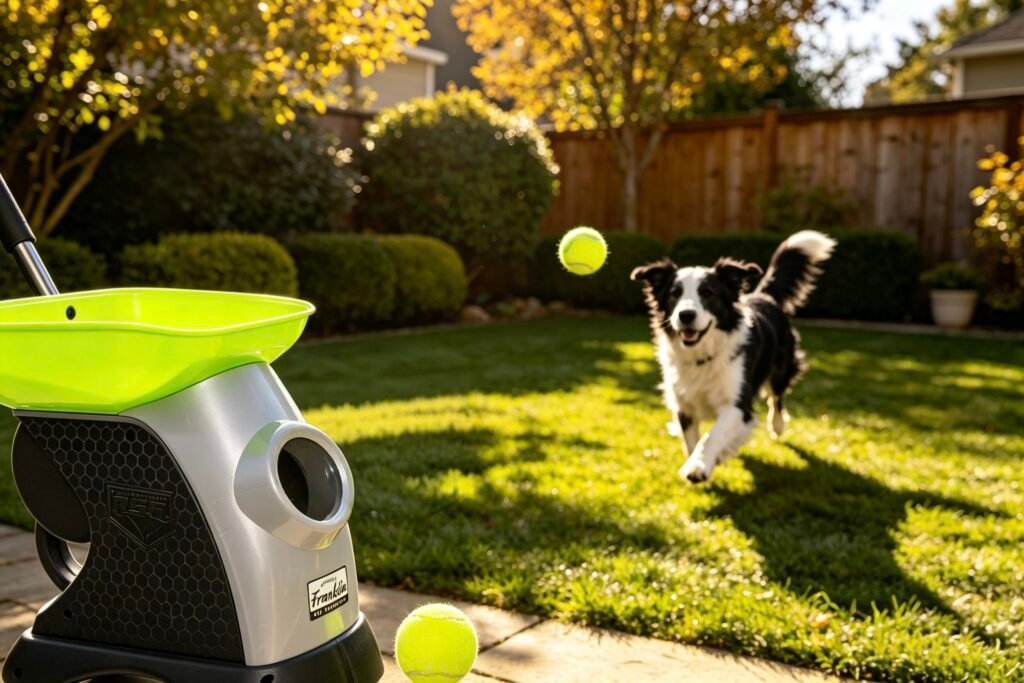
How to Choose the Best Automatic Ball Launcher for Dogs
Not all automatic ball throwers for dogs are built the same. These are the factors that actually make a difference.
Ball size compatibility — the most important spec
This is the single most important thing to check. The wrong ball size causes jams, sensor errors, and early wear.
- 5-inch standard tennis balls — for medium to large dogs. Most popular launchers use this size.
- 0–2.3-inch mini tennis balls — for small dogs. Safer, easier for smaller breeds to carry and drop back in.
Some brands only work reliably with their own balls. Always check before buying third-party balls.
Launch distance and power
Most auto ball throwers for dogs offer 3–9 distance settings, covering roughly 10 to 30+ feet. Match the range to your space. A high-powered launcher in a small room is a problem. A short-range model in a large yard will bore a high-energy dog.
Indoor vs outdoor use
Most dog tennis ball launchers work both indoors and outdoors, but check the minimum throw distance before using inside. You’ll also want quieter operation for apartments or noise-sensitive situations.
Power source
Battery models (AA or C batteries) are flexible but have an ongoing cost. Rechargeable or plug-in models cost less to run but keep you close to an outlet.
Safety sensor
A motion sensor at the front of the machine stops it from firing when your dog is too close to the opening. This is standard on most quality launchers — it’s not optional.
Noise level
Launchers make a motor hum and an alert beep before each throw. Most dogs adapt quickly. If yours is noise-sensitive, check user reviews for noise level specifically before buying.
| Factor | What to check |
| Ball size | 2.5 in for medium/large dogs · 2.0–2.3 in mini for small dogs |
| Launch distance | Match to your available space — short min. setting needed for indoors |
| Power source | Battery = flexible · Rechargeable/plug-in = lower running cost |
| Safety sensor | Motion sensor at launch opening — essential, not optional |
| Noise level | Read user reviews if your dog is noise-sensitive |
| Ball compatibility | Some brands require their own balls — verify before buying |
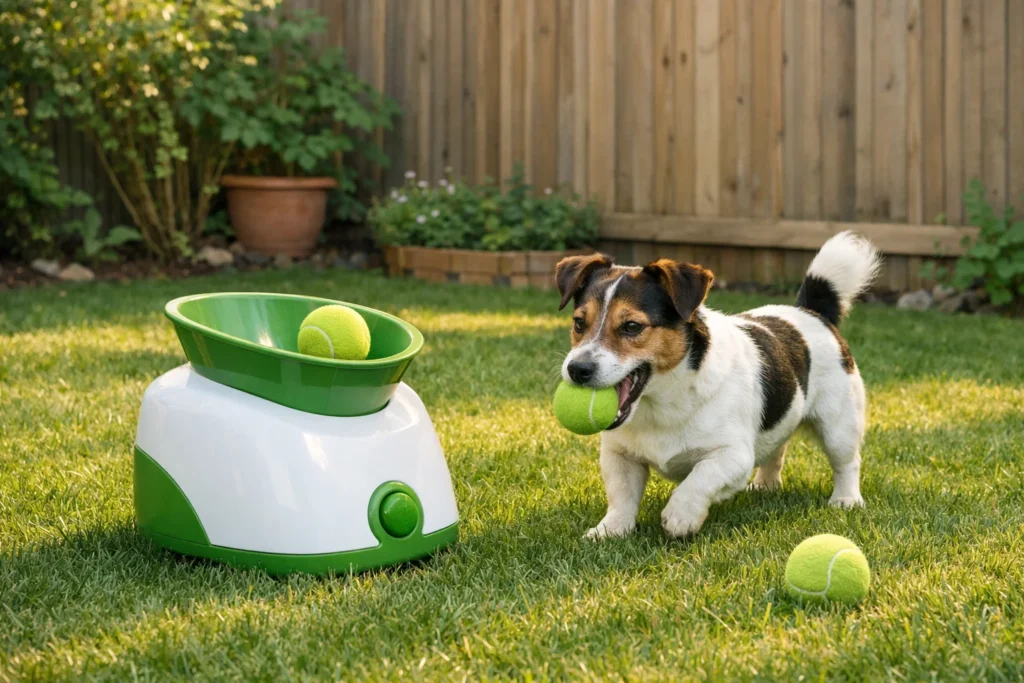
Best Automatic Ball Launchers for Dogs by Size (Small, Medium, Large)
Dog size is the biggest factor in choosing the right launcher. It affects ball size, power requirements, and how the machine holds up over time.
Large dogs (50 lbs and above)
Big breeds like Labradors, Golden Retrievers, and German Shepherds need a launcher built for heavy, frequent use. Standard 2.5-inch ball compatibility, a wide distance range, and a durable motor are non-negotiable. These dogs retrieve fast and drop the ball hard — the machine takes a daily beating.
🐕 Automatic Ball Launcher for Large Dogs — What large breeds need, safety tips, and our top-rated picks for big dogs.
Small dogs (under 25 lbs)
Small breeds need gentler power, quieter operation, and 2.0–2.3-inch mini ball compatibility. A full-size launcher with standard tennis balls is too loud, too powerful, and the ball itself is a choking risk for smaller dogs. Getting the size right matters more here than anywhere else.
🐩 Automatic Ball Launcher for Small Dogs — Key differences, safety notes, and top options for smaller breeds. Read the full guide →
Medium dogs (25–50 lbs) — use ball size as your guide
Medium dogs sit right between the two categories. The easiest way to decide: look at ball size. If your dog can comfortably carry and drop a standard 2.5-inch tennis ball, a regular launcher works well. If the ball looks big in their mouth or they struggle to drop it cleanly, step down to a 2.0–2.3-inch mini-ball model. When in doubt, go smaller — it’s safer and reduces jam risk.
Top Automatic Ball Launchers for Dogs Compared (2026)
The right launcher comes down to your dog’s size and energy level. Use this table to find your starting point, then follow the link that fits.
| If your dog is… | What to look for | Where to go |
| Large, high-energy breed (50 lbs+) | 2.5 in balls, wide distance range, durable motor | 🏆 Best Automatic Ball Launchers (all sizes & budgets) → |
| Small breed (under 25 lbs) | 2.0–2.3 in mini balls, gentle power, quiet motor | 🏆 Best Automatic Ball Launchers (all sizes & budgets) → |
| Medium — handles a 2.5 in ball comfortably | Standard 2.5 in launcher works fine | 🏆 Best Automatic Ball Launchers (all sizes & budgets) → |
| Medium — struggles with a 2.5 in ball | Step down to a mini-ball model | 🏆 Best Automatic Ball Launchers (all sizes & budgets) → |
| Any size — want top-rated options with reviews | Full comparison across all budgets | 🏆 Best Automatic Ball Launchers (all sizes & budgets) → |
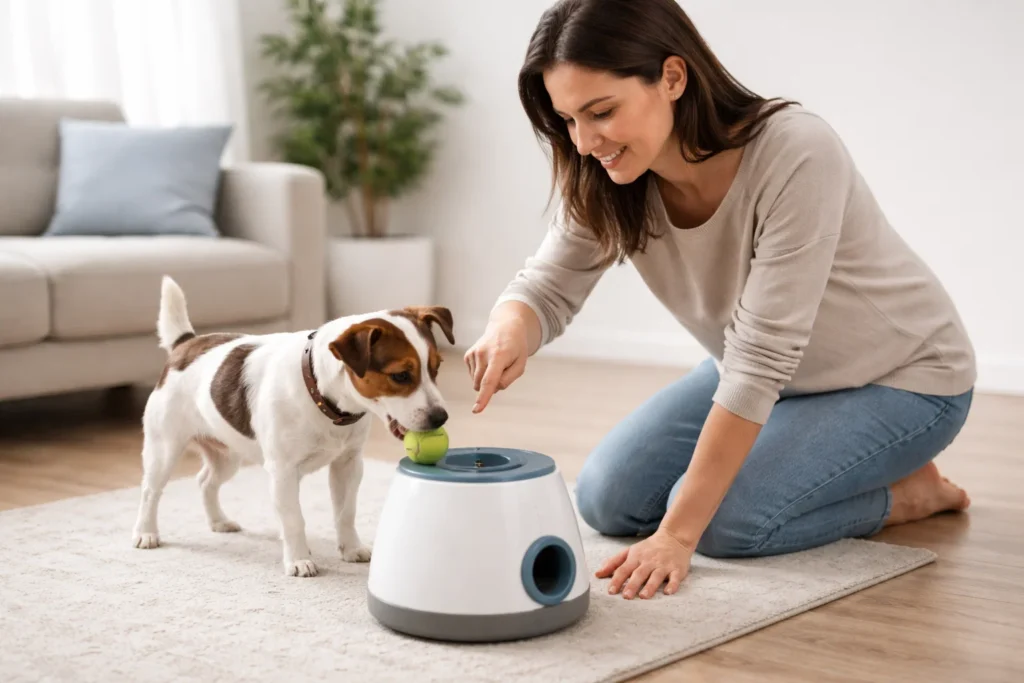
First-Time Setup and Training Your Dog
Most dogs don’t just figure it out on day one. Here’s how to introduce the machine properly — and teach your dog the drop-in habit that makes everything work.
Step 1 — Let your dog explore it first (machine off)
Put the launcher in your dog’s space with the power off. Let them sniff and investigate at their own pace. Don’t rush this. A dog that’s comfortable with the machine before it makes any noise will learn much faster.
Step 2 — Introduce the sound before the first launch
Turn it on but don’t load any balls. Let your dog hear the motor and the alert beep a few times. Reward calm behavior with treats. This step is especially important for noise-sensitive dogs. Skipping it causes fear responses that take much longer to undo.
Step 3 — First launch with your dog standing back
Load one ball and stand with your dog at your side, away from the front of the machine. Let the ball fly. Most dogs’ chase instinct takes over immediately. If they go for it — great. If not, try again the next day. No pressure.
Step 4 — Teach the drop-in
This is the skill that makes the machine self-running. Your dog needs to return the ball and drop it into the hopper at the top — not place it in front of the launch opening. Use treats to reward every successful drop-in. Most dogs get this in 3–7 sessions.
⚠️ Safety rule: Always train your dog to wait to the side of the machine after dropping the ball — not in front of the launch opening. A ball launched at close range is dangerous. The motion sensor helps, but the habit is the real protection.
Keeping Your Launcher Running Well
Most faults come from just three things: dirty chute, wrong ball size, or low battery. A few simple habits prevent nearly all of them.
| Task | How Often |
| Clean the launch chute and hopper with a dry brush or cloth | Every 3–5 sessions |
| Wipe sensor windows with a dry microfiber cloth | After every outdoor session |
| Rotate through 4–6 balls — let wet ones dry before reloading | Ongoing |
| Check balls — retire bent, chewed, or deformed ones immediately | Before each session |
| Charge the battery or check battery level | Before each session |
| Store the launcher indoors after use | Always |
If your launcher starts jamming, loses distance, or refuses to fire, the cause is almost always fixable in minutes. We cover every common fault in detail in our repair guide.
🔧 Automatic Ball Launcher Not Working? — Step-by-step fixes for jams, sensor faults, battery issues, and more — plus when to repair vs replace. Read the full guide →
Frequently Asked Questions (FAQ)
Q: Are automatic ball launchers safe for dogs?
A: Yes, when used correctly. Good models include a motion sensor that stops the machine from firing if your dog is too close to the launch opening. Always supervise play sessions and train your dog to wait to the side — not directly in front of the machine.
Q: Can I leave my dog alone with a ball launcher?
A: Not recommended. Even with safety sensors, unsupervised use carries risks: dogs can overheat from too much exercise, get too close to the opening, or jam the machine in ways that could cause injury. Most manufacturers advise against leaving dogs unattended with the launcher running.
Q: What size balls do automatic ball launchers use?
A: Most launchers for medium and large dogs use standard 2.5-inch tennis balls. Models designed for small dogs use 1.5-inch mini balls. Using the wrong size causes jams and sensor errors. Always check your model’s manual.
Q: Do automatic ball launchers work indoors?
A: Many do, but you need to check the minimum throw distance. Some models have a shortest setting of 10–15 feet, which requires a long hallway or open space. If you mainly plan to use it indoors, look for a model with a dedicated short-range indoor setting.
Q: Are ball launchers safe for puppies?
A: Most manufacturers recommend waiting until your dog is at least 1 year old. Puppies have soft, developing growth plates in their joints. Repeated high-speed sprinting and sudden stops during fetch can cause joint damage that shows up years later. Check with your vet first.
Q: How long do automatic ball launchers last?
A: With regular cleaning and correct ball size, most quality launchers last 2–4 years of daily use. The biggest causes of early failure are using wet or wrong-sized balls — both of which wear out the flywheel rubber and clog the motor faster.
Find the Best Automatic Ball Launcher for Your Dog Today
The right automatic ball launcher depends on your dog’s size, your space, and how you plan to use it. Use these links to go straight to what’s most useful for you:
- Best Automatic Ball Launchers (2026) — Full reviews, rankings, and buy links across all sizes and budgets. Read the full guide →
- Best for Large Dogs — What big breeds need and the top models that deliver it. Read the full guide →
- Best for Small Dogs — Gentler power, smaller balls, safer play for smaller breeds. Read the full guide →
- Troubleshooting Guide — Launcher not working? Fix it in minutes — or know when it’s time to replace. Read the full guide →