
Your dog’s automatic ball launcher stopped working — now what?
Most problems are simpler than they look. A dirty sensor, the wrong ball size, or a drained battery causes the majority of faults. You can fix these in minutes without any tools.
This guide walks you through every common problem — what you’ll see, why it happens, and what to do. For issues beyond DIY repair, we tell you exactly when to contact the manufacturer and when buying a new launcher makes more sense.
What this guide covers: Self-fixable problems (5 common faults) · Mechanical faults you can identify by sound and feel · A simple repair-vs-replace decision table · Maintenance tips · FAQ
How an Automatic Dog Ball Launcher Works
Understanding the basics helps you spot where things go wrong.
Most automatic ball throwers for dogs share the same core parts:
- Flywheel system — one or two rubber wheels that spin fast and fling the ball
- Hopper / tube — where you load the balls
- Sensors — a ball-detection sensor inside the chute, plus a motion safety sensor at the front
- Power source — rechargeable battery, AA/C batteries, or AC adapter
- Angle and distance settings — adjustable on most models
⚠️Design differences matter: Some launchers only work with brand-specific balls — using the wrong size causes jams. Models with wide angle adjustment have more moving parts and more potential failure points. Multi-sensor models are safer but sensors are a common fault source.
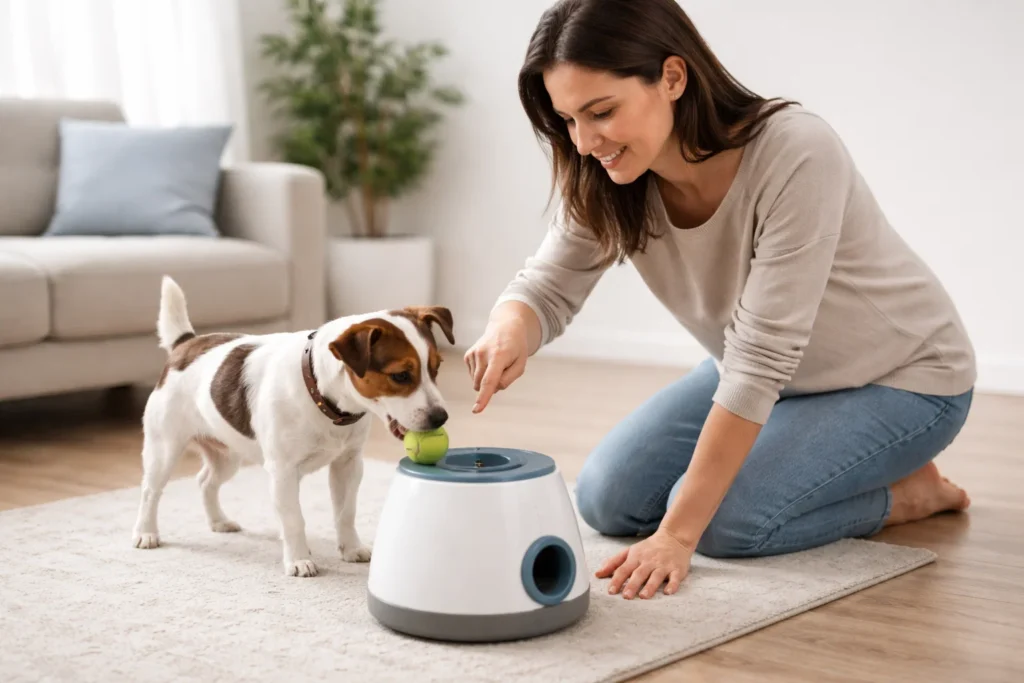
Part 1: Problems You Can Fix Yourself
Use this table to identify your problem fast, then jump to the detailed fix below.
| Symptom | Most Likely Cause |
| Ball loaded — no launch, no sound | Rest mode ON · Safety sensor triggered · Foreign object in chute |
| Ball gets stuck or drops short | Wrong ball size · Wet/swollen ball · Debris in chute · Damaged ball |
| Launch distance shorter than before | Low battery · Wet ball · Worn flywheel rubber · Motor clogged |
| Machine launches randomly / won’t fire | Dirty motion sensor · Dirty ball sensor · Sunlight interference |
| Won’t turn on / shuts off mid-play | Dead battery · Bad battery contact · Failing rechargeable pack |
Problem 1 — Ball Loaded, Machine Does Nothing
What you see: Machine is on. Ball is in. Nothing happens.
Why it happens:
- Rest mode is active. Most auto ball throwers for dogs pause automatically after 15–30 minutes of play. This protects your dog from overexertion. The indicator light usually blinks orange or red during rest. This is normal — not a fault.
- Safety sensor is blocked. There is a motion detector at the front of the machine. If your dog (or anything else) is within about 5–7 feet of the launch opening, the machine will not fire.
- Something is stuck in the chute. A foreign object, a second ball, or debris in the launch pocket will prevent the sensor from reading correctly.
Fix it:
- Wait for rest mode to end — usually 10–15 minutes. The machine will beep when it’s ready again.
- Clear the area in front of the machine. Train your dog to wait to the side, not in front.
- Remove all balls. Check the hopper and chute for debris. Clear everything out, then reload.
💡Quick tip: Teach your dog to drop the ball into the top of the hopper and step to the side. Dogs that hover in front of the launch hole cause most sensor false alarms.
Problem 2 — Ball Gets Jammed or Drops Right in Front of the Machine
What you see: The machine tries to launch but the ball doesn’t come out — or it dribbles out with no power.
Why it happens:
- Wrong ball size. This is the #1 cause of jams. Each launcher has tight size tolerances. Too large = instant jam. Too small = sensor can’t detect it, or ball flies off at a wrong angle. Some brands only work with their own balls.
- Wet or swollen ball. Tennis balls absorb water and expand. A ball that fits fine when dry can jam after a wet session on the grass.
- Built-up fuzz and dirt. Tennis ball fluff, grass, and mud accumulate inside the chute. Over time they narrow the channel and cause friction jams.
- Deformed or chewed ball. A dented or torn ball won’t travel smoothly through the mechanism.
Fix it:
- Use only the ball size specified by the manufacturer. Standard tennis balls (2.5 in / 6.7 cm) for large dog models. Mini balls (~1.5 in / 3.8 cm) for small dog models. No exceptions.
- Dry wet balls with a towel before loading. Rotate through 4–6 balls so wet ones have time to dry.
- Clean the chute after every 3–5 sessions. A dry bottle brush or cloth removes the fuzz that causes most jams.
- Throw out damaged balls immediately. They cost very little. A jammed machine costs you time.
💡 Quick tip: Keep at least 4–6 balls in rotation. Rotating lets wet balls dry between uses and cuts down on debris buildup inside the machine.
Problem 3 — Launch Distance Is Shorter Than Before
What you see: The ball launches but doesn’t travel as far — even on the highest setting.
Why it happens:
- Low battery. As charge drops, the motor gets less power. With AA or C batteries, this happens gradually — you won’t notice until the distance is noticeably short.
- Wet or heavy ball. A soaked ball is heavier and slower off the flywheel.
- Worn flywheel rubber. The rubber surfaces that grip and propel the ball wear smooth over time. Less grip = less launch speed. This is the most common mechanical wear issue.
- Motor clogged with fuzz. Tennis ball fluff inside the motor area forces it to work harder for less output.
Fix it:
- Charge fully before each session. If your rechargeable pack drains in half the usual time, the battery is aging — consider replacing the pack.
- Dry the ball before loading. Simple but effective.
- Inspect the flywheel rubber through the launch opening. Look for a shiny, flat, or glazed surface — that means the rubber is worn. Some manufacturers sell replacement wheels.
- Clear debris around the motor. Use a dry brush or a short burst of compressed air. Never use water near the motor.
Problem 4 — Machine Won’t Fire Even With Clear Space (Sensor Fault)
What you see: The area is completely clear but the machine still won’t launch — or it fires randomly.
Why it happens:
- Dirty motion sensor lens. The sensor window at the front can get coated in mud, dust, or dried saliva — making it think something is always in the way.
- Dirty ball-detection sensor inside the chute. Dirt on the internal sensor makes it misread whether a ball is present.
- Sunlight interference. Bright direct sunlight can confuse some infrared sensors, causing random launches or refusals to fire.
Fix it:
- Wipe all sensor windows with a clean, dry microfiber cloth. No wet wipes, no spray cleaners — moisture damages sensors.
- Move the machine out of direct sunlight if you notice erratic behavior outdoors.
- Turn the machine off and back on. A simple restart clears most temporary sensor errors.
- If the machine was used in rain, let it dry completely indoors before the next session. Even water-resistant models are not fully waterproof.
Problem 5 — Won’t Turn On or Shuts Off During Play
What you see: No power when you switch it on, or the machine cuts out unexpectedly mid-session.
Why it happens:
- Dead or incorrectly seated batteries. Batteries in the wrong orientation, or with corroded contacts, prevent startup entirely.
- Depleted rechargeable pack.
- Damaged charging cable or port. Common when cables are repeatedly bent or pulled.
- Aging battery pack. An old rechargeable battery can’t deliver enough current when the motor spins up, triggering automatic shutoff.
Fix it:
- Remove and reseat all batteries. Check orientation. Look for green or white powder (corrosion) on the contacts — clean gently with a dry cotton swab.
- Charge fully before use. If charge time has increased significantly or runtime has dropped, the battery pack is aging.
- Inspect the charging cable and port for visible damage. Don’t coil cables tightly during storage.
- Contact the manufacturer about replacement battery packs — some brands offer them as spare parts.
Part 2: Mechanical Faults — What the Symptoms Tell You
Some problems can’t be fixed without opening the machine. Doing that without the right tools risks further damage and may void your warranty.
But you can still identify these problems from the outside — and use that to make a smart decision about what to do next.
| What You Hear / Feel | What It Likely Means |
| High-pitched squeal during operation | Bearing friction — internal parts running dry or worn |
| Low grinding or rhythmic ‘clunk’ | Worn or chipped gear teeth inside the drive system |
| Irregular clicking during flywheel spin | Unbalanced flywheel — usually caused by bearing failure |
| Much more vibration than before | Flywheel out of balance — worsens quickly if ignored |
| Motor area uncomfortably hot to touch | Motor overloading due to internal friction — stop use |
| Erratic power — strong one throw, weak the next | Worn flywheel bearing causing inconsistent spin speed |
None of these can be fixed with a clean and a battery swap. They require disassembly, specialist parts, and tools most pet owners don’t have at home.
⚠️ Important: If your machine is still under warranty, do not attempt to open it. Opening the unit typically voids your coverage. Contact the manufacturer first.
Repair or Replace? Use This Table
Most automatic ball launchers for dogs cost between $50–$200. Internal repairs — parts + labor + shipping — often cost as much as a new machine. Here’s how to decide:
| Situation | Under Warranty? | What To Do |
| Jam, dirty sensor, dead battery | Yes / No | ✅ Fix it yourself — see steps above |
| Grinding noise, weak launch | Yes | 📞 Contact manufacturer |
| Grinding noise, weak launch | No | 🛒 Buy a new launcher |
| Chewed housing, broken flywheel | Yes | 📞 Contact manufacturer — check terms |
| Chewed housing, broken flywheel | No | 🛒 Replacement is more cost-effective |
About warranties
Most reputable brands offer a 1–2 year limited warranty. Damage from chewing is usually excluded. Normal mechanical failure is usually covered.
Keep your proof of purchase and register your product when you buy it. If the machine is under warranty and you’re experiencing any mechanical symptom from the table above, call the manufacturer before trying anything yourself.
Preventive Maintenance: Keep Your Launcher Running Longer
A few simple habits extend the life of your dog ball thrower significantly.
| What To Do | How Often |
| Clean the launch chute and hopper (dry brush or cloth) | Every 3–5 sessions |
| Wipe sensor windows with a dry microfiber cloth | After every outdoor session |
| Inspect balls — retire bent, torn, or deformed ones | Before each session |
| Rotate through 4–6 balls — let wet ones dry | Ongoing |
| Charge battery before storing | After every session |
| Store indoors — away from rain, UV, and temperature swings | Always |
| Use only manufacturer-approved ball sizes | Always |
Frequently Asked Questions (FAQ)
Q: Why does my automatic ball launcher keep stopping?
A: The most common reason is Rest Mode. Most dog ball launchers pause automatically after 15–30 minutes of play. This is a built-in safety feature to prevent your dog from overexerting. The machine will restart on its own after 10–15 minutes. If it stops at random times without a pattern, check the battery level or look for debris in the launch chute.
Q: Why is my dog ball launcher not launching far enough?
A: The three most common causes are a low battery, a wet or heavy ball, and worn flywheel rubber. Start by charging fully and drying your balls. If the problem continues after that, the flywheel rubber may be worn smooth and losing grip — some manufacturers sell replacement wheels.
Q: Can I use any tennis ball with an automatic ball launcher?
A: No. Most automatic ball throwers for dogs are designed for a specific ball size. Using a ball that’s too large will cause jams. A ball that’s too small may not be detected by the sensor. Always use the ball size listed in your machine’s manual. Some brands only work reliably with their own branded balls.
Q: My dog ball launcher is making a grinding noise. What should I do?
A: A grinding noise almost always points to internal mechanical wear — usually the bearings or gear teeth. This is not a user-serviceable problem. If the machine is under warranty, contact the manufacturer. If it’s out of warranty, buying a new launcher is usually more cost-effective than attempting a repair.
Q: How long do automatic dog ball launchers last?
A: With proper maintenance, most quality automatic ball launchers for dogs last 2–4 years with regular daily use. Key factors are how often you clean the chute, whether you use the correct ball size, and how well you store the machine. Exposure to rain, mud, and extreme temperatures shortens lifespan significantly.
Q: Is it worth repairing an automatic ball launcher?
A: In most cases, no — unless the machine is still under warranty. The cost of professional repair (parts + labor + shipping) often equals or exceeds the price of a new machine. Minor DIY fixes like cleaning and battery replacement are always worth trying first. For internal mechanical issues, buying a replacement is usually the smarter choice.
Q: What’s the best automatic ball launcher for large dogs?
A: Large dogs need a launcher with a higher launch force, wider distance range, and a standard tennis ball (2.5 in) capacity. We’ve tested and compared the top models in our full guide — see the link below.
Q: What’s the best automatic ball launcher for small dogs?
A: Small dogs need a launcher with gentler launch power and smaller ball sizes (typically mini tennis balls around 1.5 in). The wrong launcher can be too loud or too powerful for a smaller breed. Our guide includes top-rated options for small dogs.
Ready to Upgrade? Find the Best Dog Ball Launcher for 2026
If your current launcher is beyond repair — or you just want something more reliable — it’s a good time to explore what’s available in 2026.
We’ve reviewed and ranked the best automatic ball launchers for dogs across every category: best for large dogs, best for small dogs, best budget pick, and best overall. Each recommendation is based on real testing, motor reliability, sensor accuracy, battery life, and long-term durability.
More Guides You Might Find Useful
Looking for more specific guidance? These guides go deeper on related topics:
- Have a large dog at home too?→ [Best automatic ball launcher for large dogs] — standard tennis balls, longer range, built for bigger breeds
- Have a small dog at home too?→ [Best automatic ball launcher for small dogs] — smaller balls, gentler power, safer for toy breeds
- Want a full buying guide before you decide?→ See our [automatic ball launchers complete guide] — how to choose the right launcher for your dog, all in one place
- Launcher not working as expected?→ [How to fix common automatic ball launcher problems] — wet ball jams, sensor faults, and battery issues covered
- New to automatic launchers?→ [How to train your dog to use an automatic ball launcher] — step-by-step from first introduction to self-play