
Impact-Site-Verification: 0348fc84-23ab-45a3-824a-10025bed24f8
What We Noticed After Reading a Large Number of Cat Tree Reviews
After reading a large number of cat tree reviews, one issue appeared again and again:
Wobble.
Not broken parts.
Not missing screws.
But cat trees that look stable at first and then start shaking during everyday use.
These comments came from homes with different types of cats—not limited by size, age, or activity level.
However, the problem became especially noticeable after cats reached adulthood, when both body weight and usage patterns changed.
Why Wobble Shows Up Across Many Types of Cats
Wobble is not a rare issue, and it’s not limited to one specific kind of cat.
As cats grow into adulthood, they tend to:
-
jump more decisively,
-
land with greater force,
-
and use cat trees as part of daily movement rather than occasional play.
According to the American Veterinary Society of Animal Behavior, cats are highly sensitive to environmental stability. Even small, repeated movements can influence whether a structure feels safe.
This is why adult cats of many sizes may respond the same way—by avoiding unstable areas.
How to Tell If Your Cat Tree Has a Wobble Problem
Cats often notice instability before humans do.
Common behavioral signs include:
-
avoiding upper platforms,
-
jumping up and immediately jumping down,
-
limiting use to only one or two familiar spots.
The ASPCA notes that cats prefer predictable, stable environments. When a structure feels unreliable, avoidance is a common response.
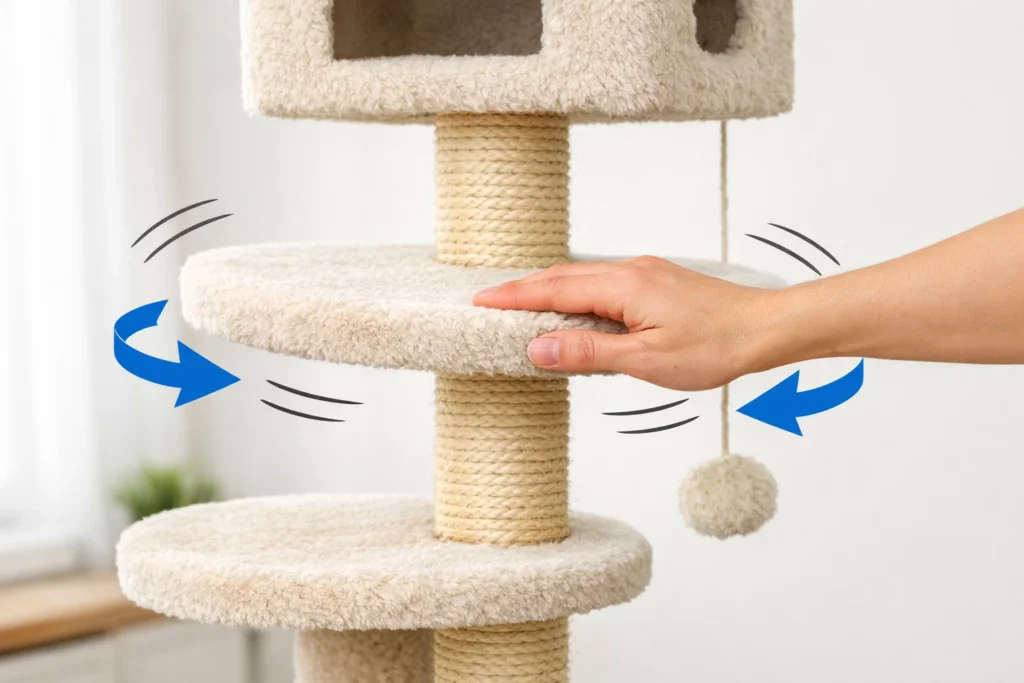
Simple Stability Checks You Can Do at Home
You don’t need tools to test a cat tree.
Try the following:
-
Gently push the middle of the structure — does the whole tree move?
-
Press down on a platform — does the motion travel through the frame?
-
Observe the base — does it stay planted or shift slightly?
Small movements that seem harmless to humans can feel significant to cats.
Why Cat Trees Start Wobbling (Brief Explanation)
Wobble usually comes from several small factors working together:
-
bases that are too narrow or too light,
-
posts that flex slightly under load,
-
tall designs without enough structural support,
-
materials that loosen gradually at connection points.
Each issue alone may seem minor. Combined, they create instability.
Why Wobble Often Gets Worse Over Time
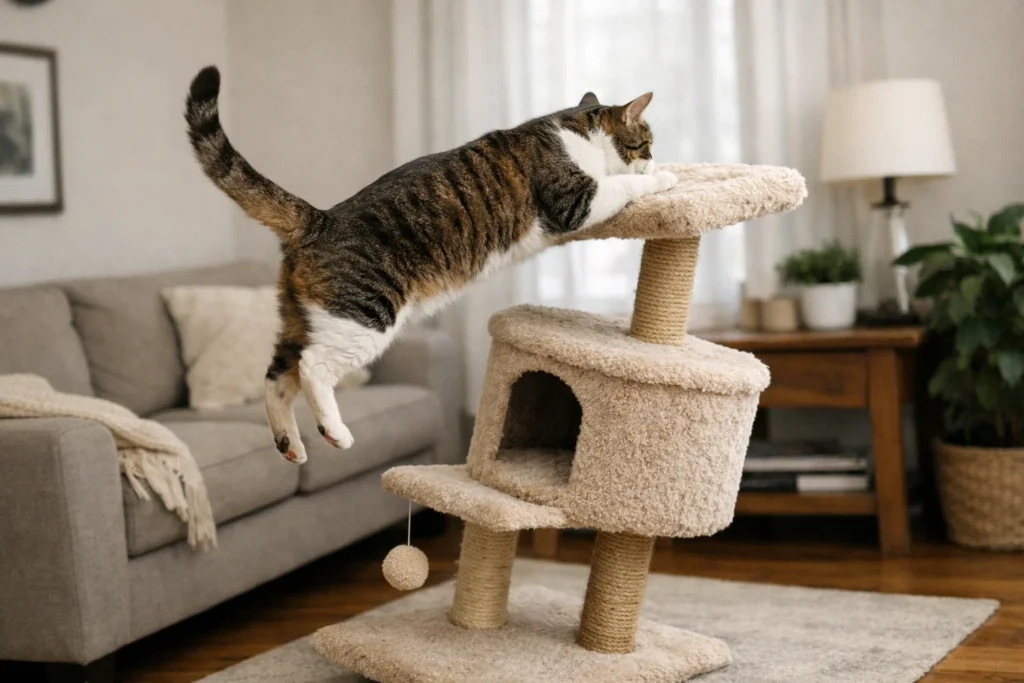
Many reviews follow the same timeline:
-
stable at first,
-
slight movement appears,
-
wobble becomes obvious.
Repeated jumping places stress on joints and fasteners.
Materials can compress, screws may loosen, and flexibility increases.
This explains why wobble is often described as a problem that develops, not one that appears immediately.
What to Look for When Buying a Cat Tree to Avoid Wobble
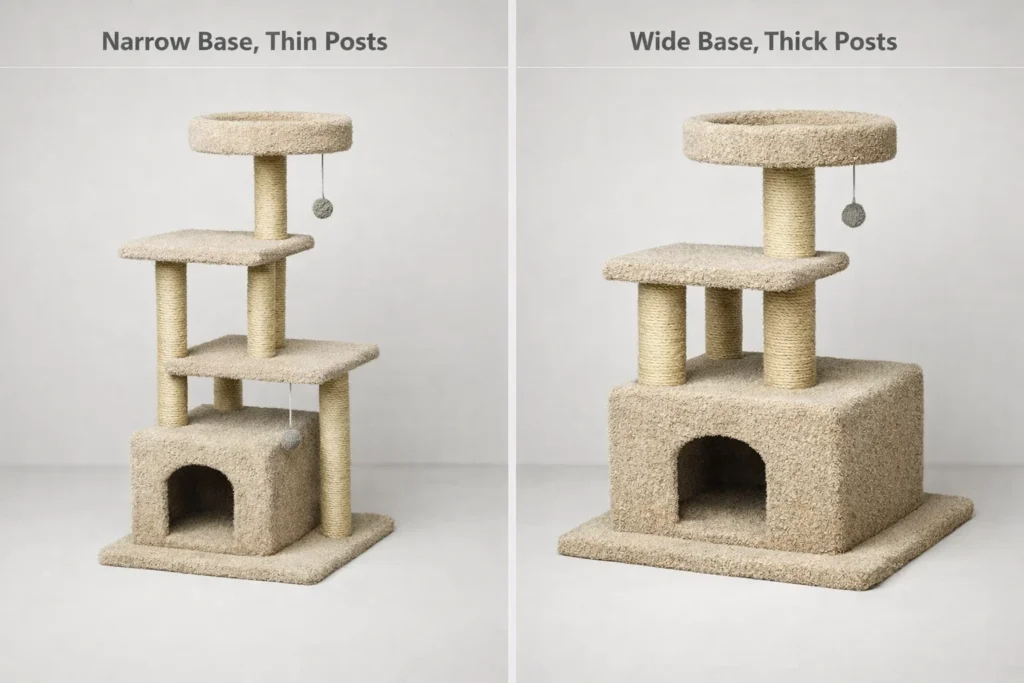
This is where wobble can usually be avoided before it starts.
Below is a quick reference table you can use when comparing options.
| What to Check | Why It Matters | What to Look For |
|---|---|---|
| Base size | Anchors the structure | Base wider than top platforms |
| Base weight | Resists side-to-side force | Feels heavy relative to height |
| Post thickness | Reduces flex during jumps | Thick, rigid posts |
| Post connections | Prevents joint movement | Secure, flush connections |
| Load-bearing materials | Maintain stability over time | Dense core materials |
| Anti-tip support | Adds safety margin | Hardware that can actually be installed |
Why Base Proportion Matters More Than Height
Extra height increases leverage.
A wide, heavy base helps counter side-to-side force when cats jump.
If a cat tree looks tall but the base looks small in comparison, wobble is more likely.
Why Post Thickness and Connection Quality Matter
Stability comes from stiffness, not quantity.
A few thick, well-connected posts often provide more stability than many thin ones.
Pay attention to how posts connect to the base and platforms, not just how many there are.
Why Material Density at Load-Bearing Points Matters
Surface fabric doesn’t determine stability.
Focus instead on:
-
base panels,
-
post cores,
-
and main connection points.
These areas determine whether the structure stays tight as your cat grows and usage increases.
Anti-Tip Support Only Helps If It’s Actually Usable
Some cat trees include wall anchors or anti-tip straps.
Before buying, check:
-
hardware length,
-
placement flexibility,
-
and whether installation works in real homes.
A usable anti-tip system can significantly reduce wobble.
Choosing for the Cat Your Kitten Will Become
Many wobble complaints don’t come from poor assembly.
They come from underestimating how a cat will use the tree as an adult.
Planning for:
-
adult weight,
-
stronger jumps,
-
and daily use
is the most reliable way to avoid wobble long-term.
A stable cat tree earns trust—and once that trust is lost, even the tallest structure may go unused.