
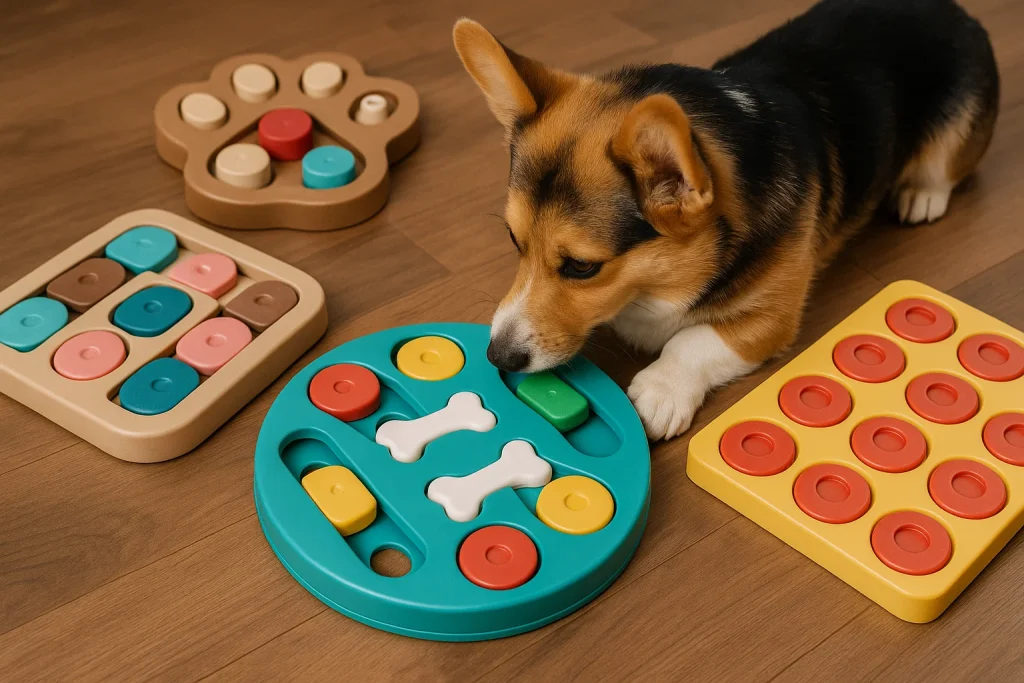
🧩 Puzzle Toys: Neuro-Regulation, Focus, and Cognitive Reinforcement 🧠
Keeping your dog mentally engaged isn’t a luxury—it’s the foundation of emotional health. Puzzle toys turn ordinary play and feeding into structured cognitive training, satisfying the instinct to forage, think, and find calm through purposeful activity.
🧘 Can Puzzle Toys Reduce Anxiety or Hyperactivity?
Short Answer: Yes. Puzzle toys offer a behavioral outlet that channels nervous energy into calm focus through neuro-regulation.
Self-Soothing Mechanism: Licking, sniffing, and searching behaviors activate the parasympathetic nervous system, releasing dopamine and promoting relaxation. This natural regulation shifts a dog from reactivity to measured, rhythmic engagement.
Therapeutic Value: For anxious dogs like Clara’s rescue, Nori, a puzzle toy becomes an emotional anchor—replacing restlessness with focused curiosity. Structured calm, disguised as play.
🧠 Do They Improve Problem-Solving or Focus?
Short Answer: Absolutely. Puzzle toys act as neural workouts, strengthening pattern recognition, memory, and spatial reasoning.
Impulse Control: Regular sessions teach delayed gratification—dogs learn to anticipate, wait, and plan. These small acts of patience build lasting focus and self-regulation.
Cognitive Gain: Sustained, gentle effort cultivates calm concentration—the mental foundation of obedience, trust, and adaptability.
🎓 Can Puzzle Toys Replace Basic Obedience Drills?
Short Answer: No—but they enhance training profoundly.
Regulation Tool: Puzzle play builds mental discipline, priming the brain for obedience cues like “sit,” “stay,” and “leave it.” Trainers often use puzzles before lessons to help dogs settle into a receptive mindset.
Deepened Learning: The process rewards curiosity over correction. As one trainer put it: “Puzzle play gets the mind quiet enough to listen.” It doesn’t replace obedience—it refines it, making learning gentler and more durable.
📈 Do Dogs Get Smarter with Consistent Puzzle Play?
Short Answer: Yes, by improving cognitive flexibility—the ability to adapt, recall, and apply patterns to new problems.
Pattern Recognition: Rotating puzzles weekly encourages dogs to transfer old solutions to new designs. Anna’s Poodle, for instance, began approaching unfamiliar puzzles with quicker insight—a clear sign of learning confidence and pattern prediction.
Neural Growth: Each solved challenge builds cognitive resilience, shaping how a dog learns, adapts, and manages frustration.
🔔 Can I Combine Puzzle Play with Treats or Clickers?
Short Answer: Definitely. Pairing clickers or treats transforms puzzle time into interactive reinforcement training.
Reinforcement: Clicks and small rewards emphasize the process—waiting, pawing, thinking—not just the outcome. This deepens focus and emotional understanding of the task.
Trust Building: Shared attention turns problem-solving into cooperation. Mia’s Border Collie, Nova, now associates puzzles with calm partnership, not competition. Through this, puzzles become quiet teachers of patience and connection.
🌿 Final Insight: Structured Calm in Daily Practice
Ten minutes of purposeful puzzle play each day resets more than energy—it restores emotional rhythm.
It builds confidence, teaches focus, and cultivates calm through repetition and shared intent.
Behavioral enrichment isn’t entertainment—it’s emotional hygiene in motion.
Small puzzles. Steady minds. Quiet progress.