
The 2026 Therapeutic Power of Scent Training: Emotional Self-Regulation and Behavioral Rehabilitation
How olfactory work rewires stress, trust, and calm through the limbic brain.
Every sniff sends thousands of scent molecules directly to the limbic system—the brain’s emotional core that governs stress, memory, and pleasure. This direct pathway explains why scent work isn’t just play—it’s therapy.
🐾 Behavioral Redirection for Destructive Habits
Short Answer: Scent work transforms chaos into calm by channeling destructive energy into goal-driven focus.
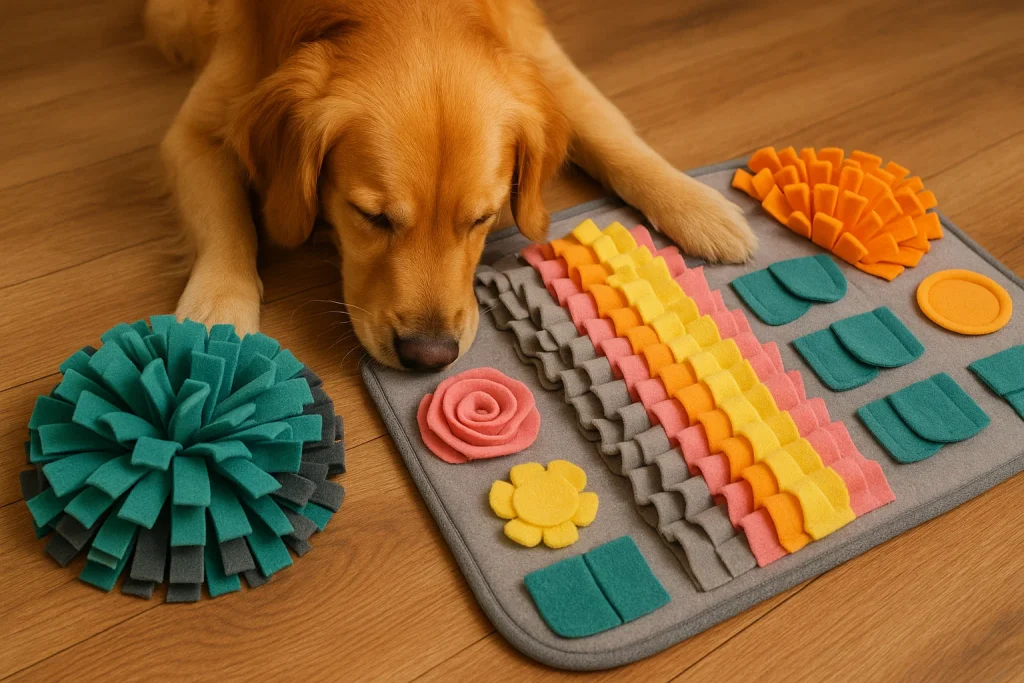
Destructive behaviors—chewing, digging, tearing—often stem from unmet foraging instincts or anxiety. Snuffle mats satisfy the natural need to hunt and achieve reward through problem-solving.
Result: The intense mental effort replaces chaotic motion with structured calm.
Example: Leah’s Husky, Nova, stopped tearing cushions once given a snuffle mat before work. “Now she sniffs, not shreds,” she said.
It’s not punishment—it’s transformation through purpose.
🎯 Enhancing Focus and Impulse Control
Short Answer: Scent training slows impulsive minds and opens the door to obedience.
The act of searching teaches self-regulation—patience, persistence, and observation. The repetitive sniffing pattern lowers heart rate and transitions dogs from a fight-or-flight to a rest-and-digest state.
Training Strategy: Conduct short snuffle sessions before obedience drills to quiet the nervous system and increase attention retention.
When Aaron’s hyperactive Golden Retriever, Max, couldn’t sit still, five minutes of sniffing changed everything. “He listens now,” Aaron said. “His brain goes from turbo to thoughtful.”
Calm curiosity is the first step toward focus.
🧠 Cognitive Fatigue: The Power of Mental Work
Short Answer: Ten minutes of scent work equals the cognitive load of a thirty-minute walk.
The olfactory cortex is one of the brain’s most metabolically active regions—during scent analysis, it consumes up to 12% more glucose, demanding true concentration.
This controlled fatigue offers dogs deep mental fulfillment—ideal for high-energy or mobility-limited pets.
When Emma’s Border Collie, Luna, was recovering from injury, scent work became therapy. “She’d sniff, sigh, and nap,” Emma said. “It was recovery disguised as play.”
Happy tired is healing tired.
❤️ Grounding Tools for Reactive and Rescue Dogs
Short Answer: Predictability and scent rhythm rebuild trust from the inside out.
For dogs with fear or trauma, snuffle mats serve as grounding tools—safe, repetitive tasks that anchor the mind and reduce cortisol spikes.
Predictable success moments provide control points, reintroducing stability in uncertain worlds.
When Mia adopted her rescue, Bear, he was terrified of every sound. The mat became their bridge. “It was the first time he wagged his tail without fear,” she said softly.
Healing doesn’t always start with touch—sometimes it starts with scent.
🐕🦺 Managing Multi-Dog Dynamics
Short Answer: Divide the field, and curiosity becomes cooperation.
Multi-dog households can experience tension if sharing one mat triggers competition. Instead, create structured boundaries:
- Use two smaller mats spaced several feet apart.
- Try modular divided mats that allow safe parallel sniffing.
- Supervise early sessions to establish calm rhythm before shared use.
When Chris’s Labradors, Milo and Zoe, fought over toys, he introduced a dual-zone snuffle mat. “They started working together instead of competing,” he said.
Scent work teaches social rhythm—peace through shared curiosity.
🌿 Final Insight: The Quiet Art of Emotional Balance
Scent training rewires emotion through focus. It doesn’t suppress instinct—it refines it, teaching dogs to replace reaction with curiosity, chaos with calm.
Add ten mindful minutes of scent work to your dog’s day. Not as a trick, but as a daily act of balance.
Healing doesn’t need noise—just the quiet patience of a nose at work.