
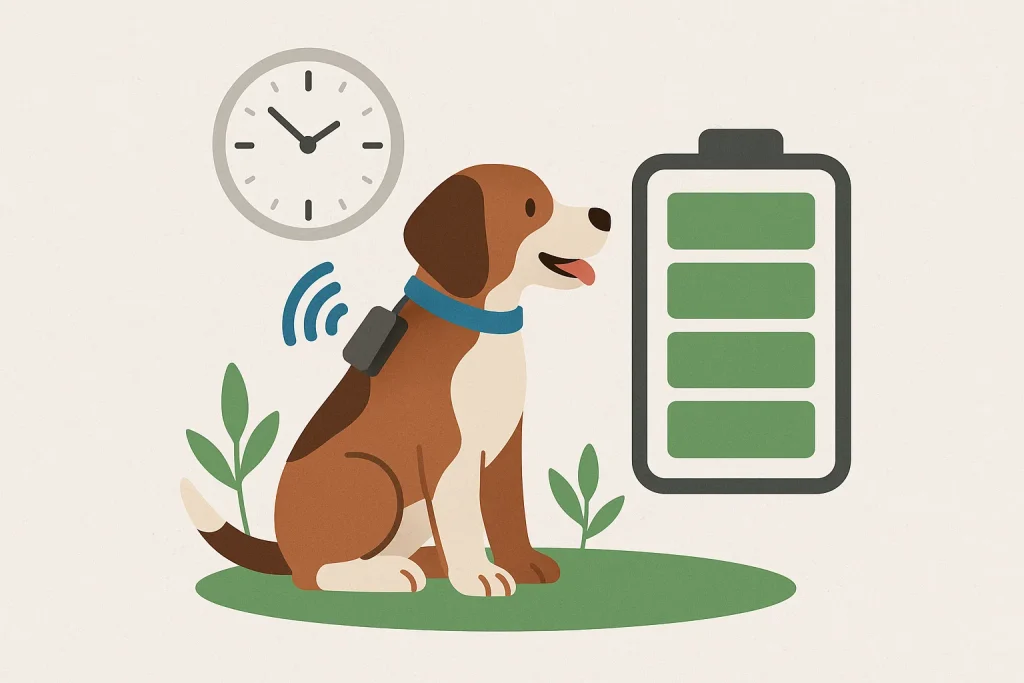
2025 Expert Guide to Battery Life, Charging & Reliability
The complete 2025 guide to battery life, charging methods, and smart power management for pet GPS trackers
Battery life can make or break a pet GPS tracker. A dead collar helps no one—especially if your dog decides to explore just as the power runs out.
Understanding pet GPS tracker battery life and smart power-saving options is key to reliability and peace of mind when every minute matters.
1. What’s the Average Runtime per Charge?
Most pet GPS collars last 2 days to 3 weeks per charge, depending on how often they update location data. Real-time tracking (frequent pings) drains battery fastest, while interval or “smart” modes greatly extend runtime.
Here’s how leading models compare in real-world battery performance:
| Brand / Model | Tracking Mode | Typical Runtime | Power-Saving Technology |
|---|---|---|---|
| Fi Series 3 | Daily activity + standby | Up to 3 weeks (≈3 months standby) | LTE-M; Wi-Fi geofencing reduces signal checks |
| Tractive GPS | Constant live tracking | 2–5 days | Power-saving zones adapt refresh rate |
| Weenect Dogs 2 | Mixed tracking | 1–2 weeks | Swappable Li-ion battery modules |
2025 Tech Insight: Trackers using LTE-M (Cat-M1) networks are far more energy-efficient than older 2G/3G devices. This technology is designed to extend GPS tracker battery life while maintaining strong connectivity.
Example: When Ben’s rescue dog Cleo went missing during a camping trip, her Fi collar still had 40% battery after four days—enough for a joyful reunion.
2. Are There Smart Power-Saving Modes?
Yes—and they’re essential for modern reliability.
Most trackers use adaptive power management that automatically lowers location frequency when pets rest or stay within known Wi-Fi/Bluetooth safe zones, cutting unnecessary data use.
Owners can customize update intervals in the app, switching between precise live tracking and low-drain standby. “Smart Mode” balances both for optimal everyday performance.
3. Do Solar-Powered GPS Collars Exist?
They do, though they’re specialized.
A few rugged models—like Spot Trace Solar or select Garmin units—include mini solar panels that passively extend runtime during outdoor adventures.
These are bulkier and best for large, active dogs spending long hours outdoors. Solar charging extends runtime but doesn’t replace wall charging.
Example: Emily hikes with her Border Collie, Rex. “I stopped packing a charger for weekend trips—it recharges while he naps in the sun.”
4. Are There Replaceable or Removable Batteries?
Most consumer GPS collars use sealed, rechargeable lithium-ion batteries for IP68 waterproofing and safety.
However, flexible options exist:
- Swappable modules (Weenect) – Swap in a charged spare instantly.
- Professional trackers – Some farm and search-dog units still use replaceable cells.
Charging tip: Magnetic connectors and fast-charging designs make routine charging quicker and more dependable.
5. Do GPS Trackers Send Low-Battery Alerts?
Yes—and you should enable them.
Brands like Tractive and Fi send push or email notifications when battery drops below 20%, giving several hours of warning. Most trackers also include a low-battery LED indicator.
Example: After Rachel’s cat Milo lost signal once, she set dual alerts at 30% and 15%—problem solved.
Why Battery Life Matters for Pet Safety
Battery life isn’t just endurance—it’s reliability when it matters most. Whether you rely on smart modes for multi-week standby or keep a spare ready, keeping that tiny lifeline charged ensures you never lose track of the love that runs on four legs.
FAQ – Quick Answers About Pet GPS Tracker Battery Life
- How long do pet GPS tracker batteries last?
Typically 2 days to 3 weeks, depending on model and tracking frequency. - Do GPS collars have power-saving modes?
Yes. Most switch to low-power mode when your pet rests or stays near Wi-Fi. - Are there solar-powered GPS trackers for pets?
Yes. Some outdoor models use solar panels to extend runtime—ideal for large dogs. - How long does it take to charge a GPS collar?
Usually 2 to 4 hours for a full charge using fast-charging connectors. - Can I replace the battery myself?
Some models offer swappable batteries, but most sealed collars use Li-ion cells for waterproofing.