How Reliable Are Pet GPS Trackers?
The complete 2025 guide to pet GPS tracker reliability across rural, urban, and extreme environments
A pet GPS tracker can be a lifeline when your dog or cat goes missing—but not every environment treats technology equally. Hills, forests, skyscrapers, and storms all test how dependable a collar truly is.
Understanding pet GPS tracker reliability in rural and urban areas helps you set realistic expectations and stay calm when the map turns fuzzy.
1. Do GPS Trackers Work in Rural or Mountain Areas?
Yes, but reliability depends on both satellite visibility and cellular coverage.
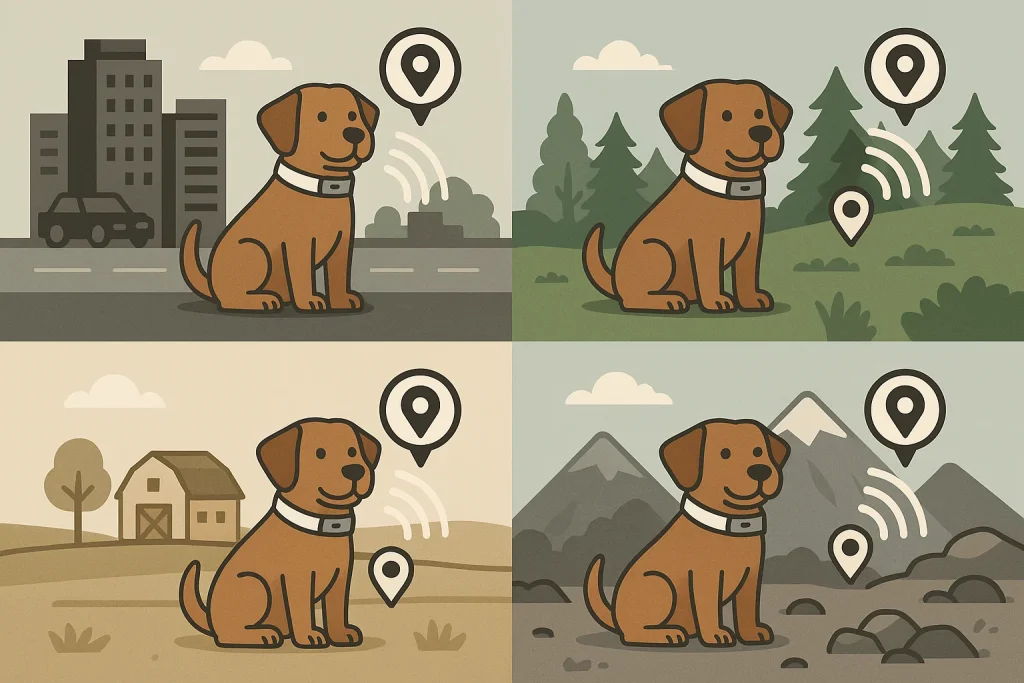
- Open country: Accuracy within about 5 m, thanks to clear satellite lock.
- Hilly or forest terrain: Mountains can block signals, creating temporary GPS dead zones.
The 2025 solution: Modern trackers use multi-constellation systems (GPS + GLONASS + Galileo) and multi-network SIMs with LTE-M connectivity for multi-carrier switching, keeping signal even in remote regions.
When Jake’s Labrador, Finn, chased a deer into the Montana hills, his Tractive collar went offline for fifteen minutes. The app later showed Finn on the next ridge—enough to bring him home.
2. Urban Canyons, Wi-Fi Triangulation & Indoor Tracking
Dense cities cause the urban canyon effect, where satellite signals bounce between tall buildings. Premium GPS collars overcome this using hybrid systems:
- Wi-Fi triangulation: Provides fast indoor and near-building accuracy.
- Cell-tower data (LBS): Fills short gaps when GPS or Wi-Fi are weak.
When Maria’s cat Nino escaped her Chicago apartment, his Fi Collar initially jumped between blocks. Once it switched to Wi-Fi-assisted mode, she found him safe—hiding in the basement laundry room.
3. Can the Collar Handle Snow, Rain, or Heat?
Most modern GPS collars are weatherproof (IP67–IP68) for rain, mud, and shallow swims.
- IP68 rating: Fully dust-tight and submersible up to 1.5 m for 30 minutes.
- Extreme temperatures: Cold or heat may temporarily reduce battery efficiency in lithium-ion cells.
For snowy climates, recharge indoors and dry devices after use. When Emma’s Golden Retriever, Scout, got lost in a blizzard, the updates slowed but never failed—the signal eventually led rescuers right to him.
4. What’s the Average Product Lifespan?
A quality GPS collar lasts 2–4 years before battery capacity fades or network standards evolve.
Extend lifespan by:
- Cleaning charging pins and contacts regularly.
- Updating firmware for better positioning accuracy.
-
Storing indoors during long inactivity periods.
Premium models with replaceable batteries or ongoing firmware support often outlast entry-level versions.
Top Factors That Affect GPS Reliability
| Factor | Impact on Performance |
|---|---|
| Network Coverage | LTE-M and multi-network SIMs reduce dead zones |
| Signal Visibility | Clear sky view = stronger satellite lock (GPS + GLONASS) |
| Weather Resistance | IP68 protection prevents dust and water damage |
| Battery Health | Low charge weakens transmission accuracy |
| Firmware Updates | New algorithms improve stability and precision |
Why Reliability Matters
Reliability isn’t perfection—it’s persistence.
Through rain, forests, or concrete canyons, the best pet GPS trackers keep that digital thread between you and your companion strong enough to lead them home.
FAQ – Quick Answers About Pet GPS Tracker Reliability
- Do pet GPS trackers work in rural areas?
Yes, if they use LTE-M and multi-constellation support to avoid dead zones. - Do buildings affect GPS accuracy?
Yes. Wi-Fi triangulation and LBS (cell-tower data) correct reflections from tall structures. - Can GPS collars handle bad weather?
Yes. IP68 waterproofing means dust-tight and submersible to 1.5 m for 30 minutes. - Can I track multiple pets in one app?
Yes. Fi and Tractive allow several collars on one synchronized map. - How long does a GPS collar last?
Usually 2–4 years, depending on battery health and maintenance routines.