
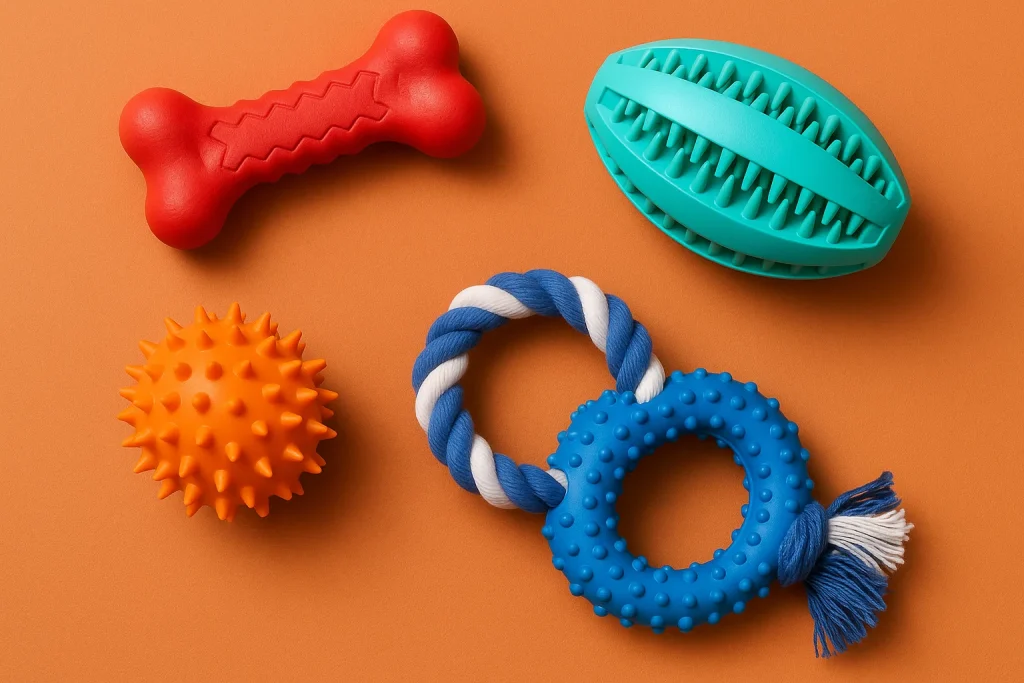
🦴 Chew Toy Guide: Size, Hardness, and Biomechanics Match 🛡️
A good chew toy doesn’t just survive your dog—it protects their teeth, satisfies instinct, and channels energy safely.
Matching size and hardness to your dog’s jaw strength is the simplest way to prevent dental injuries and choking hazards.
🦴 What Toy Size and Hardness Match My Dog’s Breed?
Short Answer: The right toy balances jaw strength and material sensitivity—firm enough to engage, soft enough to protect.
Hardness Rule (Vet-Approved):
If the toy is tougher than bone, it risks fracturing tooth enamel.
Use the “Thumbnail Test”—if you can’t press your nail into it, it’s too hard.
Breed & Force Match:
- Small Breeds (Yorkies, Chihuahuas): Soft rubber or fabric toys that flex with minimal pressure.
- Medium Breeds (Beagles, Corgis, Spaniels): Moderate-density rubber or TPE that fits the jaw comfortably.
- Large Breeds (Labradors, Rottweilers, Huskies): Thick, heavy-duty natural rubber built to absorb strong bite force safely.
When Brian’s Shepherd cracked a tooth on a dense nylon bone, his vet put it simply: “If it’s tougher than bone, it doesn’t belong in his mouth.”
💪 Which Materials Last Longest?
Short Answer: Durability depends on material integrity and chewing behavior.
Top Materials for Endurance:
- Natural Rubber (High-Density): The gold standard—flexible yet strong (e.g., KONG Extreme).
- Reinforced Nylon: Ideal for relentless, power chewers.
- Thermoplastic Elastomer (TPE): Combines elasticity with long wear and safe texture.
Safety Reminder: Rope and plush toys can fray and cause blockages—use only under supervision.
Dana’s Pit Bull, Rocky, destroyed three bargain chews in one week. A switch to Goughnuts MAXX Ring changed everything—six months later, it’s still his daily favorite.
🐾 Are There Specific Toys for Puppies or Seniors?
Short Answer: Yes—age-appropriate materials make all the difference.
- Puppies (Teething Phase): Soft, compressible rubber or silicone toys (like KONG Puppy) soothe sore gums and protect developing teeth.
- Seniors (Sensitive Teeth): Gentle plush or silicone toys encourage light chewing without strain. Comfort over challenge.
Anna’s aging Beagle, Daisy, traded her firm rubber bone for a chamomile-scented fabric toy—less chewing, more companionship.
🌍 Which Brands Are Best in 2026?
Short Answer: Look for safety certification, sustainable design, and smart innovation.
| Brand | Core Strength | Innovation/Safety Feature |
|---|---|---|
| Goughnuts | Power chewers | Built-in safety indicator core (turns red when replacement needed) |
| West Paw / Planet Pup Tech | Eco-conscious | Use Zogoflex (recyclable) + recycled bamboo/ocean plastics |
| KONG / Benebone | Broad safety | BPA-free materials + rigorous bite testing |
These brands prove that toughness and compassion can coexist—durability without compromise.
💸 Are Budget Chew Toys Worth Buying?
Short Answer: Rarely—and never for strong chewers.
Cheap toys may look identical but often lack safety testing and material purity. They fragment easily and can contain unverified plastics or dyes.
Olivia’s $6 nylon chew splintered within hours—and the vet bill cost far more than a premium toy.
Better rule: Spend once on certified quality rather than paying twice for mistakes.
🌿 Final Insight: Match Strength With Sensitivity
The safest chew toy honors your dog’s instinct, body, and bite.
Follow these three principles every time you buy or rotate toys:
- Dental Protection: Apply the Thumbnail Test—bend, don’t break.
- Size Safety: Choose toys too large to slip behind molars.
- Lifecycle Comfort: Puppies and seniors deserve soft, soothing textures over toughness.
A well-matched chew turns instinct into calm, confident, pain-free joy—the kind that lasts long after playtime ends.