
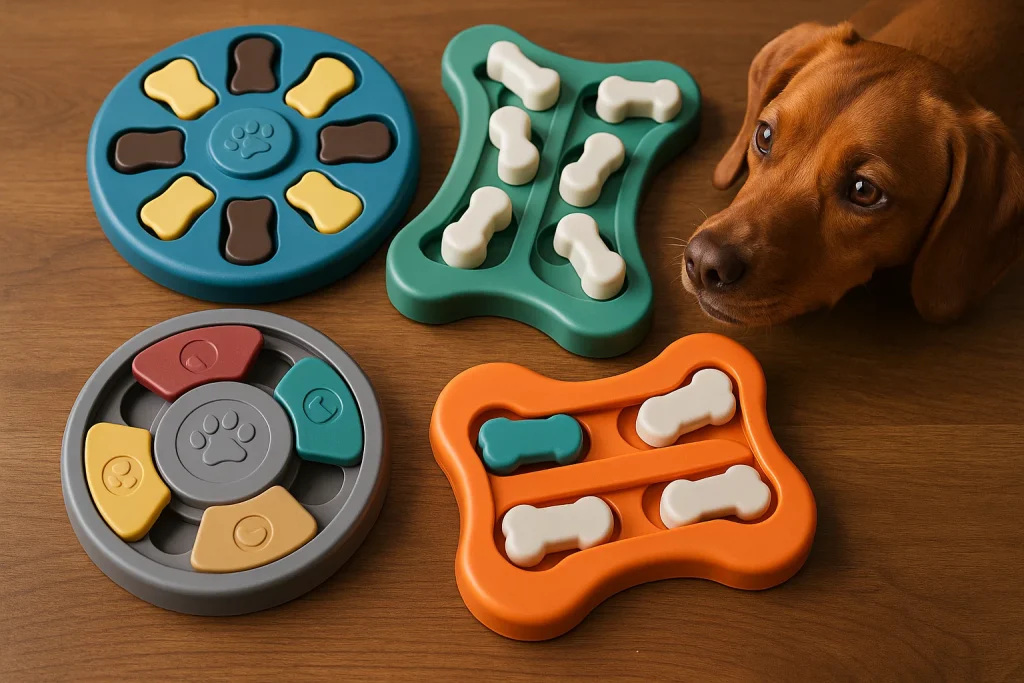
🧠 How Do Puzzle Toys Challenge a Dog’s Brain? Neurobiology and Behavioral Enrichment 🧩
Puzzle toys transform feeding or play into a neurobiological workout. By hiding treats behind sliders, spinners, or removable blocks, they activate a dog’s reward pathways—engaging curiosity, scent work, and persistence. Each solved step produces dopamine release, reinforcing focus and satisfaction.
Mechanism of Calm: Focused mental effort redirects anxious or restless energy. As seen with Sophie’s Border Collie, Jasper, a puzzle feeder turned agitation into absorption. It didn’t just feed him—it quieted the nervous system. Mental work became emotional rest.
🐾 Are Puzzle Toys Suitable for All Breeds?
Short Answer: Yes—but the right match depends on size, age, and temperament.
Selection Criteria:
- Small Dogs & Puppies: Lightweight, stable puzzles with wider openings to prevent frustration.
- Active Thinkers (Huskies, Collies, Poodles): Multi-step mechanisms that reward persistence.
- Calmer or Senior Dogs: Softer silicone mats or low-resistance puzzles that offer comfort without fatigue.
Principle of Dignity: Enrichment isn’t about difficulty—it’s about attainable challenge. The right level preserves both confidence and joy.
🍽️ Do Puzzle Toys Replace Feeding Bowls?
Short Answer: Yes—and for many dogs, they should.
Digestive Benefit: Puzzle feeders slow rapid eating, extending mealtime from 30 seconds to 10 minutes. This helps digestion by reducing swallowed air, preventing bloating, and enhancing satiety.
Dual Function: Models like the Outward Hound Slow Feeder and Trixie Flip Board combine mental challenge with nutrition delivery, turning every meal into mindful feeding.
As Tom joked after switching his Labrador, Max, to a puzzle feeder: “He eats slower now—and enjoys the challenge more than the food.”
🧠 Can Puzzle Toys Help Relieve Boredom?
Short Answer: Absolutely—they’re one of the most effective behavioral enrichment tools.
Purposeful Play: For anxious or under-stimulated dogs, puzzles provide structure and purpose, transforming frustration into focused engagement.
Behavioral Rewiring: The consistent reward loop teaches patience and replaces destructive habits with curiosity-driven calm.
A rescue owner shared that her terrier’s pacing stopped after daily treat-maze sessions. It wasn’t magic—it was focus displacing frustration.
🛡️ Do Puzzle Toys Require Supervision?
Short Answer: Yes—especially during initial training.
Training & Safety: Early guidance helps dogs learn problem-solving without resorting to chewing or flipping.
Ongoing Inspection: Once familiar, durable BPA-free designs are safe for short unsupervised play, but regular checks for cracks or loose parts are essential.
Puzzle play should challenge without overwhelming—a quiet ritual of confidence-building, mental yoga for dogs.
🌿 Final Insight: Play as Daily Therapy
Ten minutes of puzzle time a day is more than entertainment—it’s emotional hygiene.
It stabilizes mood, builds patience, and strengthens the human-animal bond.
Enrichment is not a bonus; it’s maintenance for the mind. Through small daily challenges, your dog learns what every being needs to know: calm can be earned through focus.