
The 2026 Complete Guide to Scent & Snuffle Mats: Emotional Regulation Through the Olfactory-Limbic Connection
How mindful scent work transforms feeding, focus, and calm across species.
To a dog, the world is written in scent. A snuffle mat is how we let them read it—one fold, one discovery at a time. What looks like play is, in truth, a neurochemical language of calm.
🧠 The Science of Scent: Stimulating the Olfactory-Limbic Connection
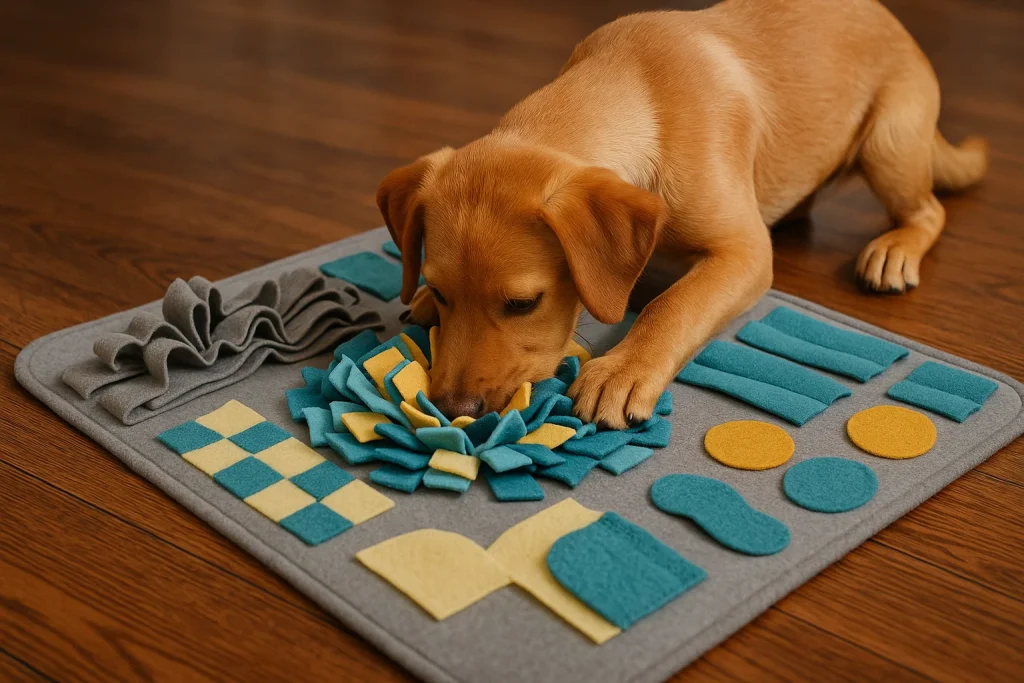
Snuffle mats are layered fabric mats that hide treats within folds, encouraging pets to use their noses to search, nudge, and uncover rewards.
Neurological Mechanism: The olfactory bulb connects directly to the limbic system—the brain’s emotional and memory center. This circuit allows scent work to trigger dopamine and endorphin release while lowering cortisol levels, producing measurable relaxation.
Cognitive Engagement: Because sniffing requires sustained attention and spatial tracking, it activates the prefrontal cortex—the part responsible for patience and impulse control. In short, sniffing trains emotional balance as much as it satisfies instinct.
When Chloe introduced her Beagle, Oscar, to a snuffle mat, she said, “He stopped pacing and started sniffing like it was his job. It was the calmest breakfast ever.”
🐕 Beyond Dogs: Multi-Species Enrichment
Snuffle mats aren’t just for dogs—they provide mental and sensory enrichment for cats, rabbits, guinea pigs, and ferrets.
- Cats mimic stalking and pouncing through foraging play.
- Rabbits & Small Pets satisfy their natural digging and nibbling behaviors safely indoors.
- Customization: Add catnip or dried herbs depending on the species’ preference, and assign separate mats in multi-pet homes to avoid competition.
Modern designs now feature adjustable textures and depths, turning one mat into a sensory playground for multiple species.
🍽️ Replacing the Food Bowl: The Physiology of Slow Feeding
Snuffle mats act as effective slow feeders, transforming rushed eating into mindful nourishment.
Digestive Benefits: Extending mealtime from seconds to minutes reduces air intake, aids digestion, and stabilizes gut rhythm—crucial for breeds prone to bloating or GDV.
Hormonal Regulation: Slow feeding helps balance hunger hormones like ghrelin and leptin, promoting a steadier sense of fullness and preventing overeating.
When Laura replaced her Shepherd’s bowl with a snuffle mat, breakfast stretched from 30 seconds to five focused minutes. “He eats slower,” she said, “and he’s calmer after.”
💞 Snuffle Mats as Canine Mindfulness Tools
For anxious or reactive dogs, snuffle mats serve as a behavioral anchor—a portable, scent-based decompression tool.
Therapeutic Use: Behaviorists integrate sniffing sessions into desensitization and counter-conditioning programs to redirect stress into reward-based focus.
Situational Calm: 5–10 minutes before storms, car rides, or bedtime helps dogs settle through scent-driven self-regulation.
Aromatherapy Integration: Incorporating lavender-scented treats enhances this calming ritual, combining olfactory therapy with reward-based comfort.
When Megan’s rescue dog, Luna, trembled during thunderstorms, her lavender-scented mat became a sanctuary. “Now she stays busy and grounded,” Megan shared.
🍎 Optimal Content: Mixing Textures for Enrichment
Variety sustains motivation.
- Dry Kibble: Clean, predictable, ideal for daily feeding.
- Soft Treats: Add challenge through scent intensity.
- Mixed Textures: Try crushed biscuits, freeze-dried meats, or dog-safe fruits for cognitive freshness.
Avoid sticky or oily foods. Shake out debris after use and machine-wash weekly to maintain hygiene and scent clarity.
🌿 Final Insight: The Scent of Cognitive Balance
A snuffle mat doesn’t just feed hunger—it feeds focus, trust, and emotional equilibrium.
Each fold holds more than food—it holds the gentle rhythm of concentration and calm.
Because in every sniff lies a small act of restoration.